By Paul Cigan, forest health specialist, Hayward. Paul.Cigan@wisconsin.gov; 715-416-4920 and Linda Williams forest health specialist, Woodruff. Linda.Williams@wisconsin.gov; 920-360-0665
Oak wilt (OW) was confirmed for the first time in Bayfield and Douglas counties and in 16 new northern townships in 2018. The new OW infections occurred on a range of properties, including county, tribal, private, U.S. Forest Service and Board of Commissioners of Public Lands. Wisconsin Department of Natural Resources (DNR) forest health staff are working proactively with affected property managers and landowners to address these infections and prioritize disease prevention and detection in the future.
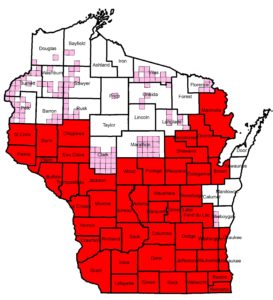
Oak wilt distribution map. Confirmed counties are displayed in red. Confirmed townships are displayed in pink 6-mile square blocks.
The greatest risk of overland transmission in northern Wisconsin is from April 15 to July 15, when fungal spores readily infect open wounds. Most of these new cases occurred during this time frame due to stem and branch damage. The primary causes of damage were roadside brush clearing, pruning, lot clearing and storm-caused branch breakage. Fungal spores may have come from diseased oak firewood and unprocessed wood recently transported into these areas.
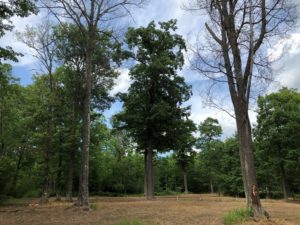
OW disease center. Oak on far left was infected through belowground root contact with tree damaged in lot clearing (far right). Dairyland Township, Douglas County (photo taken by Paul Cigan).
If oak wilt is present in or within 6 miles of the county where you manage oak, your management activities may be affected by seasonal harvesting restrictions to reduce OW introduction and impact. Read DNR’s oak harvesting guidelines for more information and refer to the list below of new 6 square mile blocks by township and county to see if OW has been detected near your property.
| Bayfield County |
| Barnes |
T45N R9W |
| Cable |
T43N R7W |
| Drummond |
T45N R8W |
| Douglas County |
| Dairyland |
T43N R15W |
| Gordon |
T44N R11W |
| Langlade County |
| Elcho |
T34N R11E |
| Langlade |
T33N R13E |
| Neva |
T32N R11E |
| Sawyer County |
| Couderay |
T39N R8W |
| Hayward |
T41N R8W |
| Hunter |
T40N R7W |
| Round Lake |
T41N R8W |
| Spider Lake |
T42N R7W |
| Vilas County |
| Boulder Junction |
T42N R6E |
| Lac du Flambeau |
T41N R5E, T40N R5E |
| St. Germain |
T40N R8E |
Please report any suspected oak wilt infections to your local DNR forester or regional forest health specialist and learn more about oak wilt identification and biology on the DNR oak wilt webpage. To learn more about firewood rules and how you can help reduce transmission of pests and diseases, including oak wilt, visit the DNR firewood page.
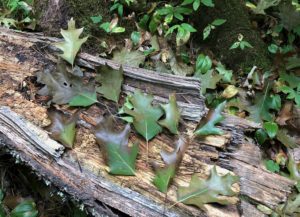
Bronzed leaves fallen from infected oak. Leaves were observed beneath infected northern red oak. Cable Township, Bayfield County (photo taken by Paul Cigan).
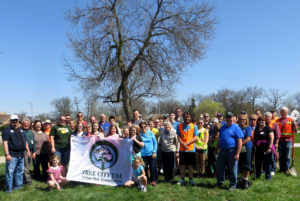 Trees make a town a special place to live. Trees shade homes, businesses and streets. They clean air and water, increase property values, reduce energy costs and make neighborhoods greener, safer and healthier. By becoming recognized and fulfilling the standards of Tree City, Tree Line, or Tree Campus USA, communities, companies and campuses are putting their citizens first and building a better community with the forest outside your door. Thousands of communities across America are enjoying these many benefits of trees and being recognized as a
  Not every city in Wisconsin has a municipal code or ordinance that includes trees, and even then, those that do have codes may not have forest-friendly ones. A new resource has been created and has taken care of the hard work of determining if your city’s codes are forest-friendly; and if they are not, the resource provides advice on how trees can be more welcome in your neighborhoods.