Seedlings still available for spring 2018 planting

Although a snowy spring has slowed work at the state nursery in Boscobel, the reforestation staff is busy lifting, grading and preparing seedlings for customers. If you have not yet placed your order, there are still some species available. Hardwood tree species still available include red oak, swamp white oak, white oak, bur oak, black cherry, and black walnut. Wildlife shrubs available include choke cherry, hazelnut, ninebark, juneberry and American plum. A few additional species may become available in the coming weeks.

Call (715) 424-3700 for up-to-date information on seedling availability and to place an order.

Seedlings are to be used for reforestation, wildlife habitat and windbreak and erosion control purposes and must be planted on Wisconsin forest land. Answers to the most common questions are available on this “Frequently Asked Questions” page.


Written by Jeremiah Auer, Regeneration Specialist, jeremiah.auer@wisconsin.gov, 715-459-1999

How are communities handling EAB across Wisconsin?

The Wisconsin Department of Agriculture, Trade, and Consumer Protection (DATCP) has recently issued a statewide quarantine for emerald ash borer (EAB), regulating the pest in Wisconsin. Since the menace has already affected 48 of Wisconsin’s 72 counties, many municipalities have been acting on EAB management plans they set into place, including the City of Racine and Ozaukee county have been managing the pest.

Continue reading “How are communities handling EAB across Wisconsin?”

Smokey Bear sighting in Oneida County

Smokey Bear Trail Cam PhotoA Smokey Bear sighting in Oneida County this week.   This highly recognizable symbol of fire prevention has finally awakened from hibernation, just in time for ‘Wildfire Prevention Week,’ April 15-21.   Spring is Wisconsin’s peak season for wildfires.  Warm, windy and dry conditions have resulted in over 160 wildfires in the southern half of the state this year, as the snow-melt is slowly progressing to the north.  Don’t worry. Smokey is very approachable, friendly and loves to give bear hugs.  Do your part to help Smokey by getting a free DNR burning permit and making sure those fires are out before you leave.  http://dnr.wi.gov/topic/ForestFire/index.asp

Protect oak trees from oak wilt by waiting until after July to prune

By Don Kissinger, DNR urban forester (Wausau), Don.Kissinger@wisconsin.gov, 715-359-5793 and Paul Cigan, DNR forest health specialist (Hayward), Paul.Cigan@wisconsin.gov, 715-416-4920

To protect oak trees and help prevent oak wilt, the Wisconsin Department of Natural Resources advises people to avoid pruning oaks on their property from April through July.

Spring and early summer pruning makes oak trees vulnerable to oak wilt, a fatal fungal disease that rapidly kills trees in the red oak group and weakens those in the white oak group. Any tree damage during this time creates an opening that exposes live tree tissue and provides an opportunity for the oak wilt fungus to infect the tree.

The red oak group includes northern pin oak, northern red oak, red oak and black oak; the white oak group includes bur oak, swamp white oak, white oak and English oak.

Pin oak (Quercus palustris)

Pin oak (Quercus palustris)
Photo: Gary Fewless, University of Wisconsin, Green Bay

“It takes only a few minutes for beetles that carry oak wilt spores to land on a fresh wound and infect your tree,” said Paul Cigan, DNR forest health specialist in Hayward.

Property owners with oak trees are encouraged to check with their municipality to find out if there are local oak wilt ordinances which may have different pruning restrictions.

The use of tree paint or a wound dressing is not normally recommended on pruning cuts or wounded surfaces on most trees. But for damaged oaks, the use of such products are suggested from April through July. An immediate light painting of wounds or cuts on oak trees during this time helps protect against the spread of oak wilt by beetles.

Don Kissinger, a DNR urban forester in Wausau, said there are also other important reasons to avoid pruning many kinds of deciduous trees in spring beyond concerns about oak wilt.

“Spring is the time when tree buds and leaves are growing, leaving the tree’s food reserves low,” Kissinger said. In general, the best time to prune trees is in winter.

Oak wilt and other diseases move easily on or in firewood logs year-round. To protect trees in general, don’t move firewood long distances, or only use firewood labeled as Wisconsin-certified.

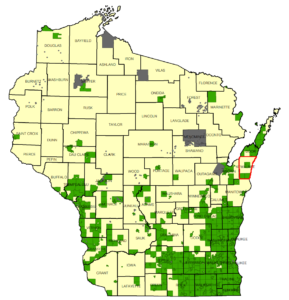
As of January 31, 2018, oak wilt has been found in all Wisconsin counties except Douglas, Bayfield, Ashland, Iron, Forest, Taylor, Door, Kewaunee, Calumet, and Manitowoc counties. Several of these counties contain the highest abundance of healthy and productive oak forests in the state. Taking recommended precautions with living oak trees and keeping firewood local to prevent the spread of oak wilt will help keep them that way for years to come.

More information is available online at the WI DNR website, including a recently released video on oak wilt. Visit the DNR website, https://dnr.wi.gov/, and search for “oak wilt” or “firewood.” Additional information about proper pruning techniques is available from community foresters or by searching for “tree pruning.”

SPECIAL REQUEST from DNR’s Forest Health Team

Thank you to those kind subscribers who have already completed the Forest Health News Survey which was emailed in March. If you haven’t had a chance to take the survey, we ask that you do so now.

Our goal at Forest Health is to provide you with helpful information on pest, disease and invasive plant issues in the state in a timely manner. To help us improve our usefulness to you, please click here to take the survey.

The survey will take about 10 minutes to complete. Your individual responses will be kept confidential. All responses will be compiled and analyzed as a group; a summary of the survey results will be available to you this spring. If you own forested land in Wisconsin, you will need to refer to the zonal map which you will find at the beginning of the survey.

We would be grateful if you will complete the survey by April 15, 2018. If you have any questions or concerns about the survey or wish to provide additional comments about Forest Health News, please contact Jodie Ellis at Jodie.Ellis@wisconsin.gov or at 608-266-2172.

Thank you for taking the time to complete this survey. It is much appreciated.

Statewide quarantine for emerald ash borer

By Jodie Ellis, DNR Forest Health Team, communications specialist (Madison), Jodie.Ellis@wisconsin.gov, 608-266-2172

An adult emerald ash borer.

An adult emerald ash borer.
Photo: Leah Bauer, USDA Forest Service Northern Research Station, Bugwood.org

The Wisconsin Department of Agriculture, Trade and Consumer Protection (DATCP) enacted a statewide quarantine for the invasive insect emerald ash borer  (EAB) on March 30, 2018. Previously, individual counties were quarantined when EAB was confirmed within each’s borders. Since EAB has been found in 48 of 72 Wisconsin counties, DATCP officials have determined that statewide regulation of the devastating ash tree pest is warranted.

Movement of ash wood, untreated ash products and hardwood firewood of any type to areas outside of Wisconsin will continue to be regulated by USDA’s Animal and Plant Health Inspection Service, Plant Protection and Quarantine. (APHIS PPQ). 

Within the state, Wisconsin businesses and members of the public will be able to freely move ash wood, ash products, and hardwood firewood to or from any Wisconsin county. Firewood restrictions will remain in effect on state and federal lands.

Items affected by the statewide EAB quarantine include ash wood with bark attached, larger ash wood chips, and hardwood firewood of any kind. County-by-county quarantines for gypsy moth, another invasive forest pest, remain in effect.  

The move to a statewide quarantine does not mean that the state has given up on managing EAB; it is simply a shift in strategy as EAB continues its slow spread through the state. The Wisconsin DNR will continue releasing tiny, stingless wasps -natural enemies of EAB – at appropriate sites, which it has done since 2011. The DNR also continues participation in silvicultural trials in which different ash management strategies are being tested.

Most importantly, campers, tourists, and other members of the public are strongly encouraged to continue taking care when moving firewood within the state. “The actions taken by the Wisconsin public during the last few years have significantly slowed the spread of emerald ash borer and other invasive forest pests in the state,” said Wisconsin DNR EAB program manager Andrea Diss-Torrance. “We can continue to protect the numerous areas within our state that are not yet infested – including those in our own backyards – from tree-killing pests and diseases by following precautions.” Public members should continue to obtain firewood near campgrounds or cabins where they intend to burn it, or buy firewood that bears the DATCP-certified mark, meaning it has been properly seasoned or heat-treated to kill pests.

Emerald ash borer is native to China and probably entered the United States on packing material, showing up first in Michigan in 2002. It was first found in eastern Wisconsin in 2008.

For further information on EAB in Wisconsin, visit https://dnr.wi.gov/ using key words “emerald ash borer.”

Prepare for the return of gypsy moths

By Bill McNee, DNR forest health specialist (Oshkosh), bill.mcnee@wisconsin.gov, 920-360-0942

In a few weeks, gypsy moth egg masses will begin hatching in Wisconsin. Property owners interested in reducing gypsy moth populations should consider oiling or removing reachable egg masses well before the hatch begins. Horticultural oils that suffocate the eggs are available at many garden centers and large retailers. In general, these are applied when temperatures are above 40oF and freezing is not imminent. When physically removing egg masses, scrape them into a can of soapy water and then let them soak for a few days before discarding in the trash in order to kill the eggs. Additional management options for homeowners and woodlot owners are available at the Wisconsin gypsy moth website

Gypsy moth egg masses

Gypsy moth egg masses

Property owners looking to hire a business to do insecticide treatments this spring should contact them soon. A list of certified arborists is available on the Wisconsin Arborist Association website. Additional businesses offering insecticide treatments may be found in the phone book under ‘Tree Service.’ Homeowners can also purchase insecticides, some of which are applied as soil drenches, at garden centers and large retailers. For larger areas, a list of for-hire aerial applicators is available on the Wisconsin gypsy moth website.

Although this winter’s cold temperatures in late December and early January most likely did not cause heavy egg mortality, the cold period will still help reduce gypsy moth populations this summer. According to the U.S. Forest Service, temperatures of -20°F lasting from 48 to 72 hours can kill exposed eggs. Eggs that are laid higher up on the bark of trees suffer higher mortality than those located near the ground because snow insulates the eggs from cold temperatures. Fluctuating spring temperatures can also cause heavy egg mortality.

2018 suppression spraying:

Dane County will be the only participant in the DNR gypsy moth suppression program in 2018. Aerial spraying will occur in mid- to late May at seven sites in Madison and one site in Sun Prairie. A total of 485 acres will be sprayed with a bacterial insecticide that affects only small caterpillars. Maps of the sites are available on the Wisconsin gypsy moth website.

Slow-The-Spread treatments announced:

The Wisconsin Department of Agriculture, Trade and Consumer Protection (DATCP) announced its planned 2018 Slow-The-Spread (STS) gypsy moth treatments in western counties. About 90,000 acres are scheduled for treatment at 36 sites in 14 counties, using low-flying airplanes. Treatments will begin in May and continue through late July or early August, using either bacterial insecticide or pheromones which cause mating disruption.

Map of proposed 2018 gypsy moth aerial treatments.

Proposed 2018 gypsy moth treatments will occur in these counties. Counties in yellow are scheduled for Slow-The-Spread (STS) treatments, while Dane County (in blue) will undergo a suppression spray.

Counties scheduled to receive aerial treatments are: Barron (3 sites covering 2,736 acres); Bayfield (1 site, 787 acres); Buffalo (6 sites, 11,754 acres); Burnett (2 sites, 4,529 acres); Chippewa (4 sites, 12,794 acres); Crawford (4 sites, 5,971 acres); Douglas (1 site, 789 acres); Dunn (5 sites, 43,986 acres); Eau Claire (1 site, 674 acres); Grant (1 site, 497 acres); Green (1 site, 392 acres); Lafayette (2 sites, 527 acres); Rusk (1 site, 463 acres); and Vernon (3 sites, 3,785 acres).

More information on STS treatments may be found online at the DATCP Gypsy Moth website.