
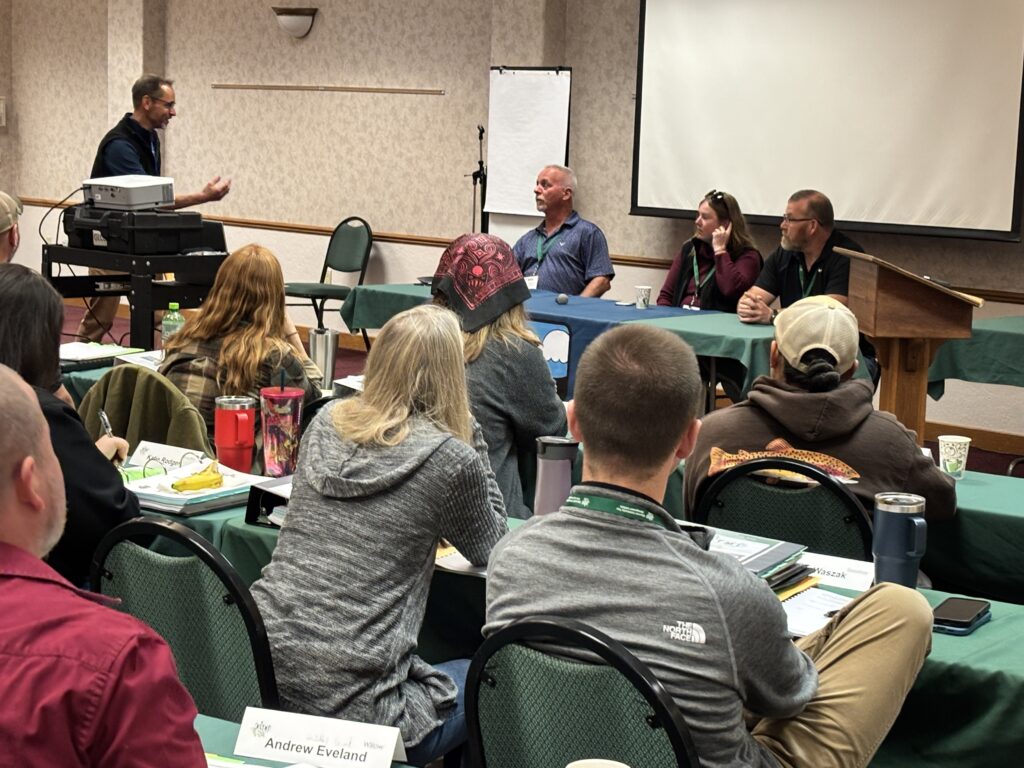
Photo Credit: Wisconsin DNR
*These training opportunities are provided as an information service only and do not constitute endorsement by the Wisconsin Department of Natural Resources.
See below for information on training topics and events, including invasive species, biochar, climate change, tree care, emergency response, tree ID and biology, insurance issues, municipal programs, volunteer opportunities and research project presentations.
EAB Network
Controlling The Belowground Spread Of Oak Wilt: Research Updates From Minnesota
Oak wilt (caused by Bretziella fagacearum) continues to be one of the most damaging threats to Quercus species in the Upper Midwest and eastern United States. Most new oak wilt infections annually occur as the result of belowground spread through grafted root systems; therefore, stopping belowground spread is a central approach to disease management. This talk reports on recent and ongoing Minnesota research building on existing oak wilt containment methods and improving their efficacy. We present results from a five-year evaluation of a practitioner-developed model for vibratory plow line placement on high disease hazard sand plain sites, in which we compared single versus double-pass vibratory plow lines for disease containment.
When: Sept. 29, 2026, 11 a.m. CT
Where: online
Register online.
U.S. Forest Service EAB Resistance Ash Breeding Program Update
Although emerald ash borer (Agrilus planipennis, EAB) has decimated ash populations in large parts of the natural range in the northeastern U.S., in some stands, a few trees, called lingering ash, remain alive. Scientists clonally replicated these lingering ash trees and used them in bioassay experiments of adult EAB feeding preference and larval development. They found that many lingering ash genotypes killed more EAB larvae, and some were more effective at suppressing larval development compared to susceptible trees. Scientists are now evaluating the lingering ash in plantings and are carefully estimating the genetic diversity using DNA-based markers. Over the next few years, the data will be combined to build the first improved seed orchards for white and green ashes.
When: Oct. 6, 2026,11 a.m. CT
Where: online
Register online.
Arrival Of Non-Native Forest Insects: Patterns, Processes And Problems
This talk will cover the mechanisms that enable non-native forest insects to move between continents. It will evaluate how patterns of arrival change among insect groups, between countries and through time and discuss what is being done to combat invasions before they start.
When: Oct. 13, 2026,11 a.m. CT
Where: online
Register online.
Management Of Some Invasive Trees Of The Eastern U.S.
This session will outline some control and management tactics for some commonly encountered invasive tree species.
When: Oct. 29, 2026,11 a.m. CT
Where: online
Register online.
Urban Forestry Today
Applications Of Biochar In Urban Forestry
Urban trees face a myriad of challenges, including poor soil conditions. Join Dr. Emily Silver from Michigan State University as she discusses the various uses of biochar for soil remediation aimed at improving urban tree health. CEU available.
When: Oct. 1, 2026, 11 a.m. CT
Where: online
Visit www.joinwebinar.com & enter 667-126-819 to join.
Understanding The Impacts Of Climate Change & Urban Trees
Join Drs. Roman, Cecala and van Doorn as they discuss how a changing climate may impact the future of our urban forests. Tips and strategies to incorporate best practices to help adapt to and mitigate change will be discussed. CEUs available.
When: Oct. 22, 2026, 11 a.m. CT
Where: online
Register online.
University Of Florida Extension
Incentive-Based Policies For Tree Protection: A National Review
UF School of Natural Resources and Environment Ph.D. student Aline Kuzma presents a national review of incentive-based policies for tree protection—spotlighting urban forest incentives for private property owners across the U.S.
When: Oct. 1, 2026, 11:30 a.m. CT
Where: online
Register online.
Urban Trees On Stress Levels: An Environmental And Socioeconomic Analysis In Florida
Join UF Environmental Horticulture Ph.D. student Suzie Suhendy as she shares her research on how urban trees and neighborhood conditions in Florida communities impact stress and well-being.
When: Oct. 8, 2026, 11:30 a.m. CT
Where: online
Register online.
Overcoming Barriers In Urban Tree Planting And Care
Postdoctoral research fellow and urban geographer Dr. Elizabeth Riedman of UCLA’s Luskin School of Public Affairs shares research on overcoming barriers to participation in urban tree planting and care.
When: Oct. 15, 2026, 11:30 a.m. CT
Where: online
Register online.
Branching Out: The Under-Examined Role Of Urban Tree Giveaway Programs And Urban Greening In Florida
Dr. Lillian Dinkins, a recent graduate of the University of Florida School of Forests, Fisheries and Geomatic Sciences, discusses tree giveaway programs and how organizations expand urban tree canopy to build more resilient cities.
When: Oct. 29, 2026, 11:30 a.m. CT
Where: online
Register online.
Morton Arboretum
Woodland Trees
Explore the ecology of various tree species and find out why they grow in each habitat. Learn about special considerations for restoring our native tree species.
This program includes self-paced online components and an in-person session at the Arboretum.
Instructor: Katrina Lewin, plant records coordinator, The Morton Arboretum
When: Access online materials: Oct. 1, 2026, noon CT
In-person session: Oct. 7, 2026, 9:30 a.m. – 12:30 p.m. CT
Where: TreeLearning and Thornhill Education Center (parking lot P-21), West Side
Register online.
Ecosystem Concepts
Develop your knowledge of ecological food webs and species interdependence and learn how to manage natural areas in ways that support biodiversity. In this class at The Morton Arboretum, participants will discuss influential variables that determine habitat quality and shape an ecosystem—such as light, water, fire and herbivory. An emphasis on the cyclical nature of the seasons and life history of native species will provide insights for short-term and long-term natural areas management.
This program includes an online component you will complete on your own and a scheduled in-person field session at The Morton Arboretum.
Instructor: Dave Hodge, environmental scientist and owner, Turning Leaf Conservation
When: Access Self-Paced Components Online: Oct. 1, 2026, noon CT
In-Person Session: Oct. 10, 2026, 9 a.m. – noon CT
Where: TreeLearning and Thornhill Education Center (parking lot P-21), West Side
Register online.
Tree Anatomy And Physiology For Professionals
Learn the different parts of a tree, how they function and what practical implications this has for a professional.
Jargon is often used poorly—both when biologists talk to arborists and when arborists talk to clients. Visiting educator and arborist Levi O’Brien will show you how to make sense of these biological principles, for yourself and clients, and how to put an understanding of tree form and function into practice. This program is intended for tree care and landscape professionals or others with previous horticulture experience.
Instructor: Levi O’Brien, arborist and educator, Levi O’Brien Tree School
Continuing education: The application for ISA continuing CEUs has been submitted. If you are interested in continuing education credit, please contact education@mortonarb.org.
When: Oct. 2, 2026, 8:30 a.m. – 3 p.m. CT
Where: Cudahy Room, Administration and Research Center (parking lot p-1), East Side
Register online.
Basic Tree ID
Tree identification is a useful skill that can deepen your connection with nature. Get to know the common trees you see in local preserves or in your neighborhood in this single-session class at The Morton Arboretum! You will learn how to identify a tree by:
- Recognizing characteristics such as leaves, bark, branches, flowers and fruit
- Using tree identification keys and field guides
- Closely observing your natural surroundings
Although the concepts you will learn can be applied to identifying trees in any region, this course will focus on examples of common trees in Illinois and the Midwest.
Instructor: Kelly Burns, education program guide, The Morton Arboretum; Lyn Myers, education program guide, The Morton Arboretum; Levi O’Brien, educator
When: Choose one session: Oct. 3, Oct. 17 or Nov. 5, 2026, 9:30 – 11:30 a.m. CT
Where: Thornhill Education Center (parking lot P-21), West Side
Register online.
250 Years Of American Woodlore
Explore the history of how trees have shaped American life and culture with arborist, educator and woodlore expert Levi O’Brien. Through stories, discussion and close observation, hike the Arboretum’s trails and learn how the physical and aesthetic characteristics of tree species, their wood and their many uses have influenced people and communities.
In this single-session outdoor program, learn about the traditions and folklore connected to America’s trees, from the role of locust and pine trees in naval battles to the ways roller skating helped transform the textile industry.
Instructor: Levi O’Brien, arborist and educator, Levi O’Brien Tree School
When: Oct. 3, 2026, 12:30 – 2:30 p.m. CT
Where: Big Rock Visitor Station (parking lot P-13), East Side
Register online.
Introduction To Pruning
Practice correct pruning techniques and learn which plants to prune now and, more importantly, which to prune later. The colder months are an excellent time to prune most trees and shrubs. Known as dormant pruning, thoughtful removal of branches during this period is easy and encourages proper spring growth. Learn which trees and shrubs to prune at different times of the year and the best practices in pruning different species of trees and shrubs.
In this interactive class at The Morton Arboretum, you will complete a 60-minute online component on your own before attending an in-person session. Spend the in-person session outdoors with an expert who will demonstrate what to prune and how to do it. Then put on your gloves, grab some pruners and try it yourself.
This program includes self-paced online components and an in-person session.
Instructor: Kim Rutkowski, horticulturist II, The Morton Arboretum
Continuing education: The application for ISA CEUs has been submitted. If you are interested in continuing education credit, please contact education@mortonarb.org.
When: Access online materials: Oct. 29, 2026, noon CT
In-person session: Nov. 7, 2026, 9 a.m. – noon CT
Where: Online and Thornhill Education Center (parking lot P-21), West Side
Register online.
International Society of Arboriculture
Advanced Arboriculture And Tree Science
This in-depth, science and research-based course is designed for tree professionals and allied industries that work with and around tree and includes discussions about the latest training, techniques, science, research and tools. CEUs available.
When: Oct. 2, 2026, 10 a.m.
Where: online
Register online.
Electrical Awareness Hazard Training
Changing policies with power companies may affect your company’s abilities to work near power lines, in some circumstances without qualified personnel. Knowing how to identify the different power lines is essential to creating a safe work zone, especially when equipment may be in close proximity to the lines. The knowledge obtained at this course will help to ensure the proper decisions are made for a safe and successful outcome on job sites with electrical hazards present.
When: Oct. 9, 2026, 8 a.m.
Where: online
Register online.
Trees And The Design/Build Industries
Many industries work with and around trees, but there are many myths and misconceptions surrounding them. If tree professionals, landscape architects, engineers and architects better understand the needs of each other, as well as the needs of trees, truly sustainable designs are a more likely outcome. This course presents research, science, standards and BMPs to help ensure our designs are both long-lasting and sustainable. CEUs available.
When: Oct. 9, 2026, 10 a.m.
Where: online
Register online.
Money Does Grow On Trees, At Least For Municipalities
This talk provides resources to green industry professionals on how to persuade denying politicians and budget makers. Avoid talking about the big-picture benefits, the niceties or the ideological concepts that seem decorative and nonessential to these non-believers. Instead, talk directly about tax dollars. It is two-fold: How do trees save money? And how do trees generate more tax revenue? All the topics we will discuss can be directly connected to line items in a government budget book. If you can directly connect the benefits of trees with a line item in the budget, you will be surprised!
When: Oct. 16, 2026, 11 a.m. CT
Where: online
Register online.
The Urban Forest Myth?
What do we really mean when we say the “urban forest”? Are we all in agreement? What does it need to thrive? How do we know? Is it similar to a natural forest? If not, how is it different? Are we making any mistakes in trying to create or maintain it? Are there studies and standards we need to apply to it? If we can’t answer these questions, we may not be helping support our urban forests. CEUs available.
When: Oct. 23, 2026, 10 a.m.
Where: online
Register online.
Wisconsin Arborist Association
Kids Climb
This is part of the annual Chainsaw Carving and Art Festival. Volunteers are needed for the following:
- Tree climbers to help kids in the trees
- People on the ground belaying the kids up the trees
- A couple logistical people to outfit helmets and saddles and sign waiver forms.
When: Oct. 4, 2026, 9 a.m. – 1 p.m.
Where: Riverbend Nature Center, Racine, WI
Sign up online to volunteer.
WAA Day Of Service
The Lion’s Camp in Rosholt, Wisconsin, is a 440-acre property that includes a 45-acre private lake to provide quality camp experiences for Wisconsin youth and adults with disabilities at no charge. The camp is in need of various forms of tree care, ranging from pruning to removals. Some of the work needed is over the camp cabins and recreation center, as well as removing hazards from the site. It would be beneficial to have bucket trucks and chippers.
Lunch and refreshments will be provided by the Lion’s Camp.
Safety: Personal protective equipment is required for everyone entering the work zones, including camp staff.
When: Oct. 7, 2026, 8 a.m. – 4 p.m.
Where: Wisconsin Lion’s Camp, Rosholt, WI
Sign up online to volunteer.
Aerial Rescue Training Workshop
When a tree worker is injured or incapacitated aloft, typically fellow crew members are the first to respond. An emergency could develop at any time, and tree care professionals must know how to react.
Aerial Rescue Training helps protect your workers and meet the aerial rescue training requirements mandated by ANSI Z133.1 and OSHA. This class is designed to be used in combination with on-the-job training and practice, so crews have the knowledge and skills needed to evaluate an emergency situation and potentially rescue an injured tree worker.
- ALL students will be required to bring and wear proper PPE (hard hat, safety glasses and proper footwear).
- ALL students should also bring climbing gear and climbing spurs to take part in a wide range of rescue scenarios (not mandatory to take class).
- All gear will need to pass inspection prior to use.
- Lawn chairs and water bottles are recommended.
When: Oct. 24, 2026, 8 a.m. – 3:30 p.m.
Where: ENSA Access and Rescue, Mukwonago, WI
Register online.
Illinois Arborist Association
Careers In Arboriculture Demonstration Event
The IAA Careers in Arboriculture Demonstration Event is designed to help career-seeking professionals interested in arboriculture do just that. Attendees will get to see live arboricultural practices and applications in action, demonstrating how the work is actually done. You’ll interact with current arboriculture professionals and ask questions to learn more about the types of work that might interest you most. Alongside the demonstrations, we provide lunch, networking and a career fair to help attendees learn of current opportunities available in the industry.
The arboriculture industry is much more than chainsaws and large equipment. Attendees will learn of and explore the spectrum of career opportunities, services and organizations within the industry that best fit their passions, desires and skillset in a career in arboriculture.
Attendees will be responsible for their own travel to and during this event. Lunch and refreshment breaks are provided.
When: Oct. 7, 2026, 8 a.m. – 4:30 p.m.
Where: The Morton Arboretum. Lisle, IL
Register online.
Urban & Community Forestry Society
Trees, Insurance & Risk: Navigating A Changing Landscape
This session explores how emerging insurance trends, policies and requirements influence urban forestry decision-making. You’ll gain an understanding of the tree care industry’s response, including efforts by the Tree Care Industry Association and the Urban and Community Forestry Society and collaborations with the National Council of Insurance Legislators to influence policy discussions. Most importantly, you’ll leave with practical strategies for navigating insurance-related concerns with clients, communities and municipalities, including how ANSI industry standards provide liability protections, how to strengthen contractual and RFP language and how ordinances and regulations intersect with insurance considerations.
Join us to get ahead of the conversation, anticipate insurance-related challenges, strengthen your risk-management approach and help shape a future where the insurance industry and tree care industry work together to protect trees and urban canopy goals. CEUs available.
When: Oct. 5, 2026, 2 p.m. CT
Where: online
Register online.
Wisconsin Forestry Center
Tree Biology
This three-day Tree Biology Workshop combines classroom learning with hands-on field experiences to help participants better understand how trees grow and respond to their environment. Through interactive discussions, live dissections and real-world case studies, attendees will explore tree anatomy, wood structure, root systems and the science of Compartmentalization of Decay in Trees. Participants will also learn how to evaluate tree structure and compare different nursery stock and planting systems. Whether you are an arborist, urban forester, landscape professional or passionate tree enthusiast, this workshop will provide practical, science-based knowledge that can be applied to improve tree health, planting success and long-term tree care.
When: Oct 6-8, 2026
Where: Sparta, WI
Register online.
PennState Extension
Decay Demystified: Understanding Mushrooms And Tree Decay
Dig into the fascinating world of mushrooms in this two-part webinar series. Learn to distinguish fungi that harm living trees from those that recycle dead organic matter and build healthy soil. Using real mushroom samples, participants will explore key features and identification techniques for major fungal groups while examining the ecological roles of fungi, including beneficial and parasitic relationships with trees. Participants will gain practical skills for spotting decay pathogens, assessing tree health and using reliable resources for accurate mushroom identification. CEUs available.
When: Oct. 7 & 14, 2026
Where: online
Register online.
Arbor Day Foundation
Using Tech to Track + Treat Invasive Pests and Diseases
Invasive and emerging pests rarely announce themselves. Emerald ash borers can hide inside a tree for three or four years before any visible decline appears, and a pathogen like Swiss needle cast can quietly reduce a Douglas-fir’s growth for years before anyone notices the crown thinning out. By the time the damage is obvious, the response is reactive, expensive and playing catch-up.
This free webinar brings together tree care professionals and municipal foresters who are getting ahead of that curve by using mapping and inventory data to track pest and disease pressure early, deciding between treatment and removal and building the case for funding before a problem becomes a crisis.
Presenters will share how they’ve used software to track three very different threats. Despite their differences, all three stories show the same throughline: spatial, historical data changes what’s possible.
When: Oct. 8, 2026, 11 a.m. CT
Where: online
Register online.
Tree Fund
Education And Impact Through Community Groups, TREE Fund Education Grants
The Western Land Conservancy in Ohio will present their education program, “Western Reserve Land Conservancy’s Tree Steward Training Program” at their Ohio campus where they graduated 39 Tree Stewards to be caretakers of trees and related projects.
Cornell Cooperation Extension in New York will present their education program, “Urban Tree Equity Education and Outreach” from 2025-2026, where they engaged a wide range of people to educate and engage them in their surround urban forest.
When: Oct. 9, 2026, noon CT
Where: online
Watch for registration information online.
ArborPro
Mapping The Urban Forest At Street Level: Mobile LiDAR For Municipalities & Utilities
In this webinar, we explore how mobile LiDAR technology is transforming the way industries like municipalities, utilities and urban forestry professionals collect, analyze and use tree data.
Stay tuned as we examine the fundamentals of LiDAR and explore how mobile LiDAR captures complex street-level data that can be transformed into valuable information to better understand and manage the urban forest as critical and profitable infrastructure. We will also compare mobile LiDAR with traditional tree inventories and discuss where it provides the greatest value and where conventional methods make more sense for your organization or projects. Registration is free, and attendees will earn 1.5 ISA CEU credits for participating.
When: Oct. 15, 2026, 1 p.m. CT
Where: online
Register online.
Utility Arborist Association
From Maps To Mitigation: Using GIS To Identify And Prevent Environmental Risk Hotspots In Utility Work
This webinar explores how GIS can help utilities identify environmental risk areas before fieldwork begins. Attendees will learn how integrating environmental and operational data improves planning, supports better decision-making, reduces permitting challenges and helps teams deliver resilient, compliant projects through real-world GIS-driven workflows.
When: Oct. 20, 2026, noon CT
Where: online
Register online.
Midwest Invasive Plant Network
2026 Upper Midwest Invasive Species Conference
The Upper Midwest Invasive Species Conference is a biennial conference that addresses all taxa of invasive species. In 2026, UMISC will celebrate 18 years of connecting the invasive species management, research and policy community. The goal of UMISC is to strengthen management of invasive species, especially prevention, control and containment. There have been great strides in invasive species research, prevention and management, but much work still must be done. The conference provides numerous opportunities to network with professionals, land managers, researchers, nonprofits and others.
When: Oct. 6-8
Where: online and in-person in La Crosse, WI
Register online.
Engaging Hmong And Southeast Asian Communities In Invasive Species Awareness
How can we foster shared stewardship and better bridge the gap between formal conservation management and the traditional ecological knowledge of Southeast Asian communities? During this webinar, the University of Minnesota Extension will share insights from early-stage work, highlighting lessons learned and ongoing efforts to adjust their approach.
When: Oct. 28, 2026, CT
Where: online
Register online.
Resource of the month:
Celebrating Wisconsin’s Forests And Forest Products (Oct. 18-24, 2026)
Wisconsin’s forests cover nearly half our state and are a vital part of our collective history, culture and economy. Likewise, the forest products industry provides valuable jobs and contributes significantly to the economy. Forest Products Week offers an opportunity to learn about sustainable forest practices and to develop an appreciation for the valuable resources that Wisconsin forests provide.
Businesses and organizations across Wisconsin have come together to present engaging programs about the forest products industry. Whether you’re curious, passionate or just looking to learn something new, there’s something happening near you.
Sign up to receive email updates regarding Forest Products Week.