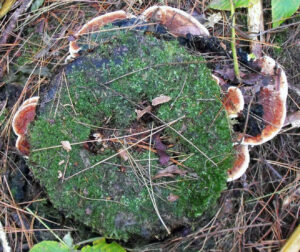
Heterobasidion root disease grows from an infected tree stump. / Photo Credit: Wisconsin DNR
By Kyoko Scanlon, DNR Forest Pathologist, Fitchburg
Kyoko.Scanlon@wisconsin.gov
Fall is a great time to look for mushrooms, including conks from trees infested with Heterobasidion root disease (HRD).
Considered one of the most destructive diseases of conifers in the northern hemisphere, the fungus causing HRD is very difficult to eradicate once established. Infestation of a conifer stand, especially pine and spruce, may significantly impact stand management, making early detection of the disease extremely important.
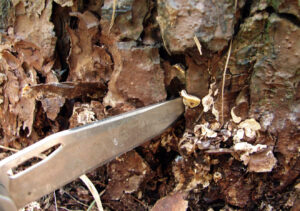
In the early stages, fungal growth by the HRD pathogen can resemble popcorn. / Photo Credit: Wisconsin DNR
In fall, look for shelf-like growth at the base of dead trees and stumps. New HRD fruit bodies are bright white; older fruit bodies add layers of new growth to look like a conk, making them easier to detect.
You may need to scrape away needles and other debris at the base of a conifer to find the fruit bodies.
In their initial state, HRD fruit bodies may be small, similar in shape to popcorn. Under favorable conditions, fruit bodies grow into a shelf-like conk that becomes light gray to brown on the upper surface.
HRD fruit bodies are usually found near the ground line. But they may be found higher than a foot off the ground. Also, they may grow flat. Although they can be found in many different shapes and sizes, the undersides of the fruit bodies are pores, not gills.
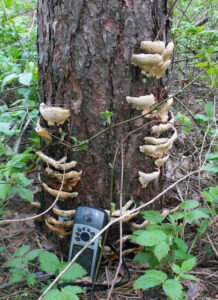
Shelf-like conks grow from the main stem of a tree infected with Heterobasidion root disease. / Photo Credit: Wisconsin DNR
Fungicides can be applied to protect fresh cut stumps from being infected with HRD. Although a biological fungicide, Rotstop® C, is no longer sold in North America, borate-based fungicides, Cellu-Treat® and Tim-bor® Professional, are registered and available for use to prevent HRD in Wisconsin. Both products are available for purchase in 25-pound buckets. In addition, Tim-bor® Professional can also be purchased as a 1.5-pound bag. A small bag may match well with the needs of a private landowner who owns a small woodlot.
If you find HRD fruit bodies, contact a Wisconsin DNR Forest Health specialist to report it. The DNR is tracking every HRD location in the state.
For more information about preventing HRD infestation or about Wisconsin’s HRD guidelines, visit the DNR HRD webpage.
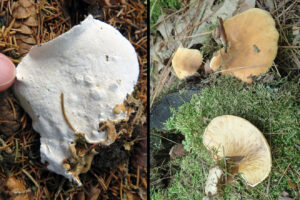
Left: Upon closer inspection, the underside of a Heterobasidion root disease fruit body shows pores, not gills. Right: A lookalike fungus that is not Heterobasidion root disease shows gills, not pores, on its underside. / Photo Credit: Wisconsin DNR
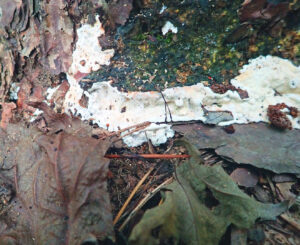
A flat fruit body of Heterobasidion root disease grows on the ground line. / Photo Credit: Wisconsin DNR