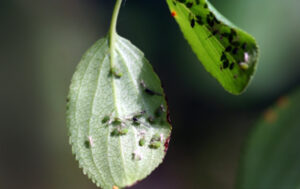
Soybean aphid on common buckthorn leaves. / Photo Credit: Christina DiFonzo, Michigan State University, Bugwood.org
By Kelsey Taylor, DNR Forest Invasive Plant Coordinator, Eau Claire
Kelsey.Taylor@wisconsin.gov or 608-471-2206
Many resource managers and landowners work hard to limit the growth and spread of invasive buckthorn to benefit forests and wildlife. But did you know that efforts to control buckthorn, especially near agricultural fields, can also benefit crops such as soybeans and oats?
Wisconsin is a patchwork of agricultural and forested areas, often intersecting at ecological crossroads and producing overlooked or unnoticed impacts on one another. There are ways that efforts to control invasive buckthorn can have positive impacts across ecological jurisdictions on these versatile landscapes — an important extra benefit effect that is often not emphasized or even considered.
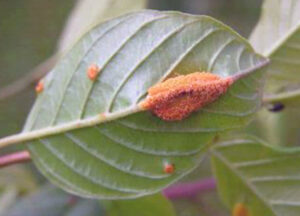
Crown rust fungus on glossy buckthorn. / Photo Credit: Milan Zubrik, Forest Research Institute, Slovakia, Bugwood.org
Buckthorn impacts forest health and ecosystems by outcompeting native species for space and resources, and they can impact agricultural yields by serving as overwintering hosts to pests and pathogens that affect species grown in Wisconsin.
Common buckthorn (Rhamnus cathartica) and glossy buckthorn (Frangula alnus) are well-known invasive plants that disrupt forest ecosystems by outcompeting native vegetation, reducing native understory regeneration and degrading wildlife habitat. These invasive buckthorns also serve as overwintering hosts for soybean aphid eggs and adult soybean aphid reproduction (Iowa State University Extension and Outreach, 2026). According to the Wisconsin Department of Agriculture, Trade, and Consumer Protection (DATCP), soybean growers were forecasted to harvest 4.53 billion bushels of soybeans in 2026, up 6% from 2025. That’s a lot of plants for the hungry soybean aphids to potentially damage as they spread from buckthorns to agricultural fields.
Fall is a great time of year to manage buckthorn, as the plant is often easily identifiable in forested landscapes at this time of year. It holds on to its green leaves longer than most native species, making it stand out in stark comparison against the earth-toned colors of fall.
By removing or otherwise controlling buckthorn when the plants are easily visible in the fall and early winter, we can not only aid in improving forest understory, but we can also disrupt the life cycle of the plant pest soybean aphid (Aphis glycines) and the fungus pathogen crown rust (Puccinia coronata) to reduce their impacts in adjacent agricultural areas in future growing seasons. Thinking about this intersection of agriculture and forestry may help us prioritize management in the future for this prolific invader.
Soybean aphids feed on the above-ground parts of plants, and in heavily infested areas can lead to yield losses of up to 40% (Iowa State University Extension and Outreach, 2026). By controlling buckthorns in wooded areas near soybean agricultural lands in the winter, we can help reduce impacts from soybean aphid to crops in future growing seasons (Matt Russell, 2024).
In addition to being an overwintering host for soybean aphids, buckthorn also serves as an overwintering host for the crown rust fungus (Puccinia coronata), which primarily affects oats. According to DATCP, oat production in Wisconsin is forecasted to harvest 4.42 million bushels in 2026, up 6% from 2025. Grain yield can be reduced by the crown rust fungus by a whopping 10% to 40% (Cereal Disease Lab, St. Paul, Minnesota; Oat crown rust, 2017).
Reproduction of the crown rust fungus occurs on buckthorn in the late winter/early spring months, so removal of buckthorn helps to prevent the spread of rust into pastures and cropland.
Looking into the future as we think about where to prioritize buckthorn management for healthy forests, we can also think about how healthy forests play a part in Wisconsin’s agricultural landscape. And this gives us one more reason why managing buckthorn is great for Wisconsin forests and agricultural lands.
For More Information
The following links carry more information on the topics discussed in this article:
- DNR invasive species webpage on common buckthorn
- DNR invasive species webpage on invasives control
- DATCP webpage on agricultural programs, including soybeans and grains, and pests
- University of Wisconsin-Madison Division of Extension webpage on pest management for crops and soils