
By Abby Krause, DNR Urban Forestry Coordinator
Abigail.Krause@wisconsin.gov or 608-556-5690
What’s in a name? That which we call a tree by any other name would stand as tall. Okay, maybe that’s not exactly how the Shakespeare quote goes, but in the urban forestry world, what we call a tree does play into our management decisions.
As communities work to recover from the devastation inflicted by invasives pests and build resilience against future challenges, species diversity rules have become the guide for planting projects. Planning out care of trees once they’re in the ground also revolves around knowing which species are present. How are we tallying our progress toward diversity goals, relaying the specific species we want to order from the nursery or narrowing down what’s ailing that tree in the park?
With names, of course.
The most familiar tree names are common names. Many Wisconsinites can proudly proclaim the common name of our state tree, the sugar maple, even if they’re not pulling Acer saccharum out of their noggins. Common names are easily recognizable, hold cultural significance and sometimes hint at identifying features. For example, I would call Acer negundo a boxelder. However, one of our northern neighbors might tell you it’s a Manitoba maple. Yet someone else might refer to it as an ash-leaved maple. All of us would be right.
The biggest hiccup with common names happens when multiple plants share the same name. It would be frustrating to order an ironwood for your planting expecting an Ostrya virginiana to show up at your door but instead are greeted by a Carpinus caroliniana. Similarly, a resident might be worried that the mountain ash in their yard will be attacked by emerald ash borer until learning that while the common name is shared with other ashes, the genus is not.
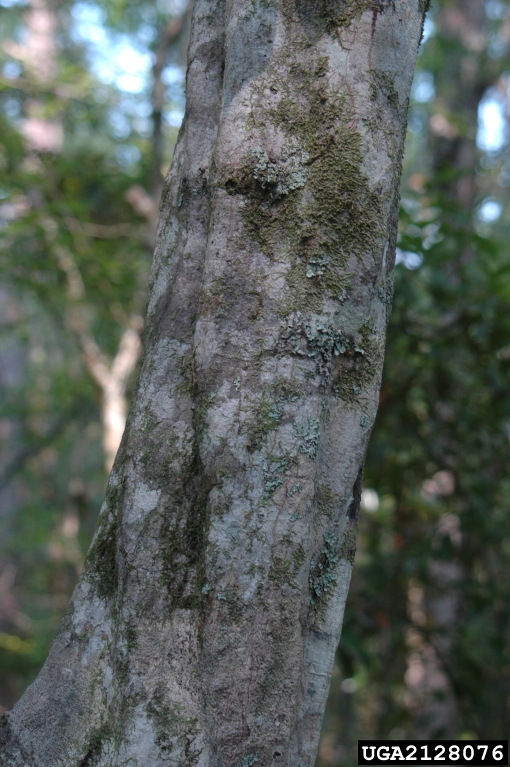
Carpinus caroliniana / Photo credit: Chris Evans, University of Illinois, bugwood.org
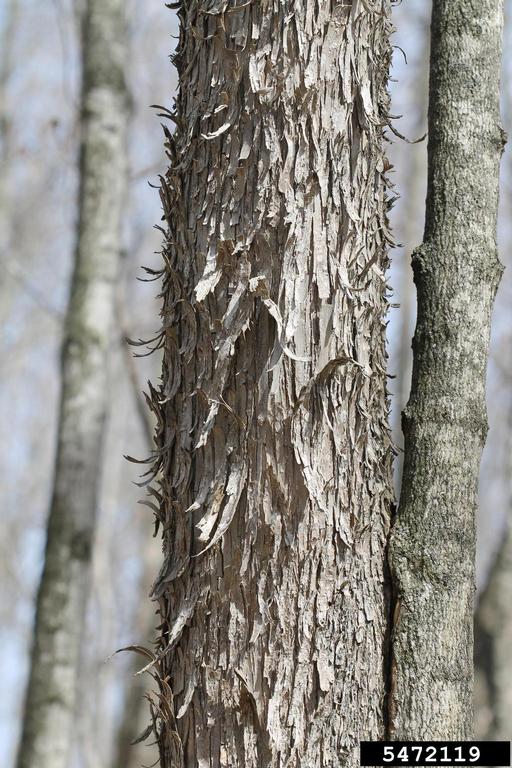
Ostrya virginiana / Photo credit: Rob Routledge, Sault College, bugwood.org
To avoid confusing situations like above, each tree has a unique scientific name. You may also hear it referred to as the botanical name, binomial name or Latin name. The scientific name will be composed of two words. The first being the genus and the second being the specific epithet (i.e. the species).
Formatting conventions make the scientific name easy to spot. The genus will always be capitalized, while the specific epithet is lowercase. Additionally, both parts will be italicized when typed out or underlined when handwritten. In contrast, common names are not italicized and are entirely lowercase unless they include a proper name like Norway spruce.
If you’ve ever looked at a suggested planting list or visited a nursery, you might have noticed that sometimes, there are extra bits in the scientific name. Three common scenarios you might come across are hybrids, varieties and cultivars (or even a combination thereof). Knowing which you’re working with can help inform management decisions.
Often, hybrids are a cross between two species in the same genus. This will be indicated in the scientific name with a multiplication sign. A hybrid you’ve likely encountered out on the streets is a Freeman maple, Acer × freemanii. It combines the stronger branch attachments of a red maple, Acer rubrum, with the speedy growth rate of a silver maple, Acer saccharinum. Additionally, hybrids are one way we get resistant trees back on the market after they are obliterated by a pest or disease, like in the case of elms.
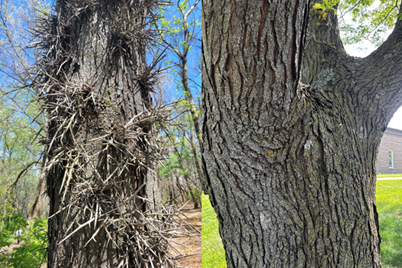
A popular urban tree, a honeylocust variety is used to improve safety and avoid the long thorns traditional to the species. Photo credit: Wisconsin DNR
Varieties possess an interesting and desirable characteristic that may be atypical to the species, such as a unique flower color. Since they are often naturally occurring, varieties tend to be “true to type,” that is seedlings will share the unique characteristic of their parent plant. A heavily utilized variety in urban spaces is thornless honeylocust, Gleditsia triacanthos var. inermis. When looking at the scientific name, there will be a nonitalicized “var.” preceding the lowercase, italicized variety name.
Cultivar is short for ‘cultivated variety’; similarly, these plants are being chosen for a desirable trait. However, cultivars aren’t always true to type when grown from seed and often need to be clonally propagated via cuttings, grafting or other methods to ensure the sought after trait is maintained. That means even if you buy 100 New Harmony elms, Ulmus americana ‘New Harmony’, you genetically have the same tree.
When writing out the scientific name, the cultivar name will be capitalized, never italicized and surrounded by single quotation marks. If a plant is both a variety and a cultivar, the cultivar name will come after the variety name. One such example is Skyline® honeylocust, Gleditsia triacanthos var. inermis ‘Skycole’.
While not part of the scientific name, another easy way to spot a cultivar can be a trademarked tree. These trees will have a ® or TM included in their common name. EspressoTM Kentucky coffeetree, Gymnocladus dioicus ‘Espresso- JFS’, is a seedless cultivar.
As with most topics, there’s so much more information and nuance we could discuss. If you would like to dig deeper, I’d suggest checking out the International Code Of Nomenclature For Algae, Fungi And Plants, the set of rules and recommendations that govern the scientific naming of those organisms. If you’re not looking for a heavy, technical code to read on the beach this summer, I hope you’ve learned a tidbit or two that will help as you map out fall plantings.