
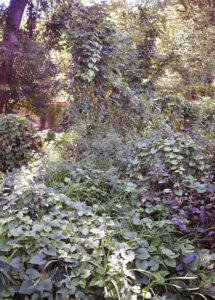
A red hailstone infestation in Dane County blankets surrounding vegetation and can be seen climbing into trees. / Photo Credit: Wisconsin DNR
By Carter Hellenbrand, DNR Invasive Plant Field Specialist, Fitchburg
Carter.Hellenbrand@wisconsin.gov
Note: This is the third installment in the Forest Health News “Invasives Spotlight” series, a series of articles released monthly during the growing season.
What is heart-shaped and hairy all over? Red hailstone!
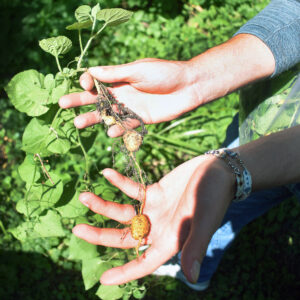
Underground tubers of red hailstone. The tubers easily break off to create new plants. / Photo Credit: Wisconsin DNR
Also known as golden creeper or Manchu tubergourd (Thladiantha dubia), this invasive perennial vine can grow 18 feet in a single growing season and spreads through underground potato-like tubers that break off from the root system to create new populations.
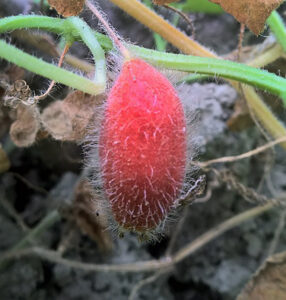
Red hailstone fruit, which appears only on female plants. Fruit from this species has yet to be observed in Wisconsin because all occurrences found in the state to date have been male plants. / Photo Credit: Rob Hille
The red, hairy fruit from this plant has yet to be observed in Wisconsin, due to there being separate male and female plants. Only male plants have been confirmed in the state, making the production of fruit not possible at this time.
Red hailstone can grow in a variety of habitats, including forests, grasslands and gardens. With the help of its tendrils, this species can easily form a blanket that smothers surrounding vegetation, including trees. This results in the shading out and displacement of native plants.
History Of Red Hailstone
Native to Asia, red hailstone was likely introduced as an ornamental in North America before becoming a regulated species in various states. In Wisconsin, red hailstone is not currently regulated under the Invasive Species Rule (ch. NR 40) but is proposed for regulation. The rule would make it illegal to transport, transfer, introduce and in some cases possess, red hailstone in Wisconsin. There have been positive detections of red hailstone in Crawford, Dane, Grant, Richland, Polk and Waukesha counties.
Identifying Red Hailstone
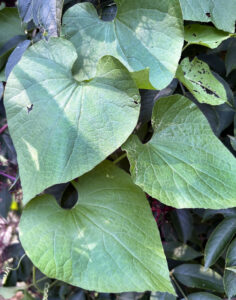
Red hailstone has heart shaped leaves, with small teeth along the margins. / Photo Credit: Wisconsin DNR
Leaves: Alternate along the stem, heart-shaped with small teeth along the edges and covered with hooked hairs.
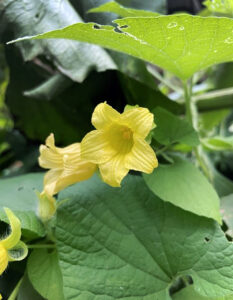
Flowers from a red hailstone plant found near Monona Bay and Brittingham Park in Madison. / Photo Credit: Wisconsin DNR
Flowers: Emerging in the summer, the flowers are yellow, tubular and consist of five petals.
Seed: The fruit of this species is covered with white hairs and resembles a small red cucumber that can be two inches long. Red hailstone fruit has not yet been observed in Wisconsin.
Lookalikes
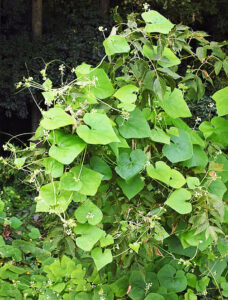
Native bur cucumber (Sicyos angulatus) with small, white flowers. / Photo Credit: Katy Chayka (copyright)
Bur cucumber: Red hailstone is part of the cucumber family. Because of this, other members of the cucumber family can be mistaken for this invasive vine. Luckily, these species can easily be differentiated, based on their flowers. Bur cucumber has white/green flowers; red hailstone flowers are yellow. This species also has fruit that looks similar to what red hailstone would produce, but the color is green to brown.
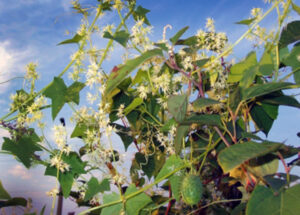
Native wild cucumber (Echinocystis lobata) with small white flower clusters and hanging fruit. / Photo Credit: Barbara Tokarska-Guzik, University of Silesia, Bugwood.org
Wild cucumber: Another member of the cucumber family that is native to Wisconsin and a red hailstone lookalike. The flowers of this species are narrow, white/green and found in clusters. The leaves are also lobed, resembling more of a maple leaf than a heart.
Reporting Red Hailstone
There is a limited number of known populations of red hailstone in Wisconsin. If you think you have found this species, please report it to Invasive.Species@wisconsin.gov. At a minimum, please include the location and clear photos of the plant’s identifiable features. Other important details, such as population size and landownership, are also encouraged.
Controlling Red Hailstone
Red hailstone can be controlled by digging up and removing the plant, along with its entire root system and tubers. However, this can be quite a challenge because the species reproduces through the tubers, which easily break off and form new plants.
The most effective control method is to use a systemic herbicide directly on the leaves (foliar application) between August and October. Be sure to read the full directions on the herbicide label to determine mixing ratios, application rates and required safety measures.