
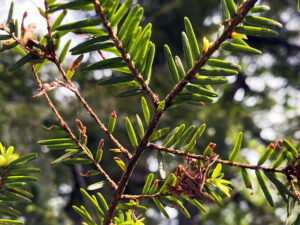
Hemlock branches show missing needles, and needles with feeding damage, as the result of spruce budworm infestation. / Photo Credit: Wisconsin DNR
By Linda Williams, Forest Health Specialist, Woodruff
Linda.Williams@wisconsin.gov, 920-360-0665
Spruce budworms are finished feeding for the year, but the damage is still being noticed. That’s especially true in areas where defoliation was severe, such as northeastern Oneida County and southeastern Vilas County.
Spruce budworm prefers to feed on balsam fir and spruce, but in areas with very high populations and severe defoliation, they will also feed on hemlock and tamarack.
In 2023, some hemlock was defoliated by spruce budworm near Three Lakes in Oneida County, and this year there was some in the Town of Sugar Camp, also in Oneida County.
Tamarack and hemlock are listed as occasional hosts in the United States Forest Service Forest Insect And Disease Leaflet on spruce budworm, so defoliation on these species is not unheard of, but it hasn’t been a common occurrence during the current outbreak in Wisconsin.
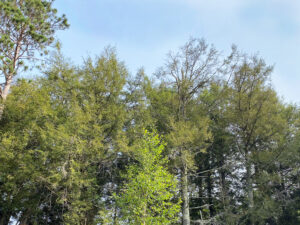
Spruce budworm feeding left the tops of these hemlock trees very thin. / Photo Credit: Wisconsin DNR
Tamarack trees that were severely defoliated by spruce budworm have already begun sending out new needles, and some of the hemlock trees also appear to be sending out new growth to replace what was damaged or eaten.
However, repeated defoliation of hemlock trees can affect their long-term health. The hemlock trees that were defoliated in 2023 were only defoliated once; today they are still alive and appear healthy.
Because there will be no more spruce budworm feeding this year, treatments are not necessary. But those trees should be monitored next spring for budworm activity early in the spring and could be sprayed at that time.