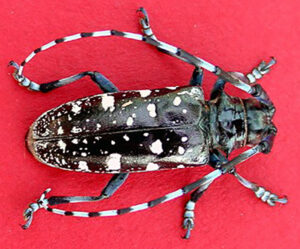
A female Asian longhorned beetle has a shiny appearance, bright spots and black-and-white striped antennae. / Photo Credit: Bugwood.org
By Michael Hillstrom, DNR Invasive Forest Pest Coordinator
Michael.Hillstrom@wisconsin.gov
More than 300 species of longhorn beetles inhabit the Midwest. The invasive Asian longhorned beetle (ALB) is not yet one of them, with no Wisconsin populations reported.
But ALB’s potential for damage is great enough that state agencies are asking members of the public to be on the lookout for the insect — and to avoid being confused by a relative lookalike.
The Wisconsin Department of Natural Resources (DNR) posted last month about ALB in last month’s Forest Health News and in a previous social media post. Forest Health staff received many photos of potential ALB as a result. Fortunately, none of the photos were of ALB – which has yet to be detected in Wisconsin.
By far, the most common insect seen in the submitted photographs was a native longhorn species called the white-spotted sawyer beetle (Monochamus scutellatus), also known as a pine sawyer beetle.
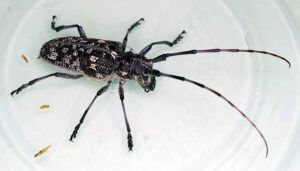
The whitespotted sawyer beetle is smaller than the Asian longhorned beetle and appears pitted or dusty, with white spots that are less distinct than on the Asian longhorned beetle. / Photo Credit: Bugwood.org
White-spotted sawyers are often mistaken for ALB. However, ALB is a stout, burly insect that makes our native sawyer beetle look slim in comparison. Additionally, ALB is very smooth and shiny, with distinct white spots on black wing covers. Its black legs also have a blue hue. Our native sawyer beetle appears pitted or dusty, and the white spots may be less distinct or absent.
Finally, our native beetle has a distinctive white dot between its “shoulders,” where the wing covers meet, and ALB does not.
This time of year, you may see these white-spotted sawyer beetles slowly flying around, especially in areas with pine or spruce trees. Their larvae develop in weakened, recently dead or recently harvested conifers for one to two years. On a summer day, you can hear the larvae loudly chewing under the bark of infested trees. They pupate within the tree, and adults chew their way out, leaving large, round exit holes. Adults feed on needles and twig bark.
Areas with storm-damaged pine, conifer decline and stressed conifers attract these beetles. Research has found that white-spotted sawyers are an ecologically important species because they help speed up nutrient cycling by breaking down the wood of trees that are already in decline.
On the other hand, ALB is a very destructive pest and major threat to maple and other hardwood trees. It is typically introduced, unintentionally, to new areas via wooden pallets, wood packing materials or firewood. The Wisconsin Department of Agriculture, Trade and Consumer Protection (DATCP) has imposed an exterior quarantine that restricts the import of regulated plant products and other items from areas infested with ALB. DATCP regulations coincide with the federal quarantine and regulations for ALB imposed by the U.S. Department of Agriculture Animal and Plant Health Inspection Service (APHIS).
Even though ALB has not yet been found in Wisconsin, early detection allows for more effective and less expensive response actions following an introduction. If you suspect you’ve found ALB, please report it and send photos to your DNR Forest Health specialist or to the Wisconsin Department of Agriculture, Trade and Consumer Protection (DATCP) Pest Hotline.