By Jane Mohler
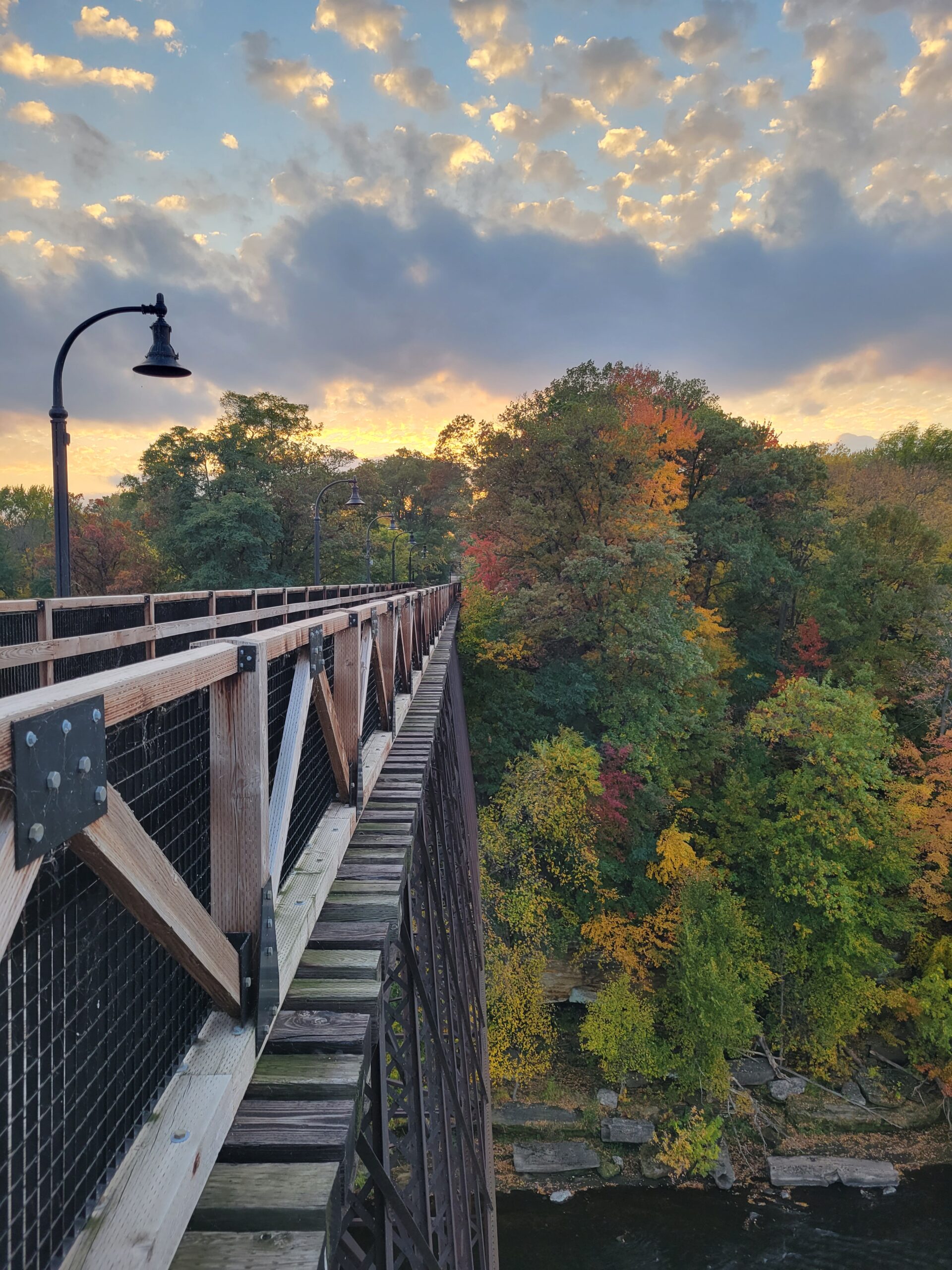
Trees flank the pedestrian High Bridge Trail in Eau Claire. / Photo Credit: Wisconsin DNR
As co‑chair of the Chippewa Valley Biodiversity Partnership and a member of the Eau Claire Urban Forest Board, I joined the 2025-26 Wisconsin DNR Community Tree Management Institute (CTMI) to expand my skillset and take advantage of networking opportunities. CTMI is an advanced training course designed specifically for people responsible for urban forest management who do not have a degree/formal training in urban forestry and/or would like to hone their leadership and management skills. This program culminates in a final project utilizing the skills and knowledge gained throughout the 38 hours of instruction.
The shared goal was simple and urgent: help Eau Claire grow an urban forest that can handle a changing climate while supporting birds, pollinators and people for decades to come. We saw a quiet but powerful opportunity in the city’s Recommended Tree List. This “go‑to” list guides what gets planted along streets, in new subdivisions, around schools and in parks—and therefore, what our canopy will look like 30–50 years from now. Updating this list with climate and biodiversity in mind became the focus of my CTMI project.
Why our Tree List Matters
Eau Claire’s canopy data told a clear story: we are heavily dominated by maples, many of them nonnative, with limited attention to wildlife habitat or climate resilience. This makes us vulnerable. If a pest or disease hits maples hard, or if hotter, drier summers stress them, we could lose hundreds of trees at once.
At the same time, research shows that healthy tree canopy helps cool neighborhoods, reduce the urban heat‑island effect and make communities more livable. Studies suggest we need around 40% canopy cover to see the strongest cooling benefits, yet Eau Claire County’s canopy was only 24% in 2025. Choosing the right mix of species matters for both comfort and safety in a warming climate.
How We Built A Better List
To move beyond “favorite trees” and personal opinion, we assembled a working group that included a research scientist, an ecologist and a municipal arborist. We then added a DNR urban forestry coordinator and additional community arborists for final review. Together, we gathered climate‑hardy tree lists from trusted sources across our region and focused on species selected for resilience and habitat value.
We combined these lists into a core set of native trees well-suited to Eau Claire and then used climate projections to look at nearby regions likely to share our future conditions. From those areas, we added additional native species that can tolerate our current cold winters, while handling warmer, wetter weather with occasional drought. Along the way, we removed known invasive species and trees that provide little benefit to local wildlife.
The final tables document our current canopy and offer clear, evidence‑based recommendations for what to plant next. They are designed to be practical for foresters, planners and residents who simply want to know: “What should we plant here?”
Guiding Principles In Everyday Language
A few simple ideas shape the list:
- Plant more native keystone trees. These are Wisconsin species that support hundreds of kinds of caterpillars and insects, feeding songbirds and powering the local food web while providing shade and cooling.
- Avoid putting all our shade in one basket. We follow a “20‑10‑5” diversity guideline: no more than 20% of trees from one family, 10% from one genus (like maples) and 5% from a single species. Right now, maples far exceed those thresholds in Eau Claire, which increases our risk.
- Match the tree to the place. The list includes information on mature size and street‑tree suitability so we can choose species that fit boulevards, yards and parks—and stay healthy once planted.
- Plan for tomorrow’s climate. Species rated “High” or “Very High” for climate resilience are expected to handle warmer summers, heavier rain events and dry spells while still tolerating our coldest winters.
- Use nonlocal natives sparingly. Some U.S. species that aren’t native to Wisconsin can survive tough urban sites, but they usually offer less value to local wildlife than our home‑grown keystones.
- Stop planting known invaders. We recommend phasing out invasive trees that currently dominate parts of the inventory because they spread aggressively and do little for birds or pollinators.
What This Means For Our Community
This CTMI project is meant to be a working tool, not just a report. Our hope is that Eau Claire’s urban forest managers, city staff, developers, neighborhoods and local partners will use the list to guide everyday planting decisions toward a more diverse, climate‑ready, wildlife‑supporting canopy.
After we completed the project, we shared it with the DNR, who featured an article on this work in the Summer 2026 issue of Wisconsin Natural Resources magazine. That statewide conversation helps reinforce a simple idea: when communities choose climate‑hardy, biodiversity‑rich tree species, every routine planting becomes an act of resilience.
For me, bringing science and practice together—working across disciplines, grounding choices in data and watching a local effort grow into a broader dialogue—has been deeply rewarding. To explore the full species list or references, you can contact us at cvbiodiversitypartnership@gmail.com (subject line: “tree list”) or visit the linked Google document.