MFI (Municipal Forestry Institute) is an exciting, high-level training opportunity educating professionals in the leadership and managerial aspects of urban forestry. Continue reading “Consider participating in MFI”
Urban Forestry News
ATC planting grant
 The American Transmission Company (ATC) is accepting applications until September 30, 2017 for its Community Planting Program. Continue reading “ATC planting grant”
Tree planting in Gillett
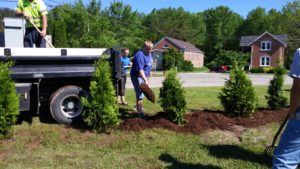 On June 7, 2017, sixty-three (63) arbor vitaes were planted in Gillett at their Nicolet Trail Campground. Continue reading “Tree planting in Gillett”
Community forests are emerging
Urban gardens and urban forests have been growing in popularity over the years. The goal of community gardens is transforming small, simple spaces into beautiful areas that can be used in many ways. Community gardens are not only for vegetables, but for trees, shrubs and grasses as well. Continue reading “Community forests are emerging”
Menomonie re-uses ash trees
Every year, Urban Forestry grants provide assistance to communities throughout Wisconsin, and can be awarded to cities, villages, towns, counties, tribes and nonprofit organizations. This year, the city of Menomonie received a $9,000 grant to help pre-emptively remove ash trees in the city parks to prevent the spread of emerald ash borer, a pest spreading throughout Wisconsin. Thirty trees will be removed and replaced with hackberry, honeylocust, Kentucky coffeetree, swamp white oak, Redmond linden and Princeton elm. Continue reading “Menomonie re-uses ash trees”
Wisconsin celebrates Arbor Day
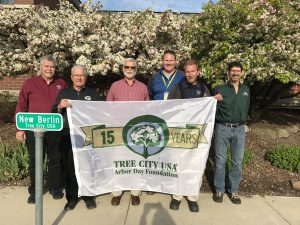 Breathe in… breathe out. The clear air that fills your lungs has been purified by trees. Clean air is one of the many ecological, economic and social benefits trees provide us. Trees also reduce crime rate, increase property values, reduce heating and cooling costs, increase tests scores, beautify communities, and provide lumber by-products. In late April, people around the world, both old and young, took time to celebrate these and other benefits by participating in Arbor Day celebrations. Continue reading “Wisconsin celebrates Arbor Day”
NAASF UCF conference review
DNR Urban Forestry staff, led by Urban Forestry Coordinator Olivia Witthun, successfully planned and executed a 4-day annual meeting for the Northeastern Area Association of State Foresters – Urban & Community Forestry Committee (NAASF UCF) in Madison in May. Continue reading “NAASF UCF conference review”
Learn about Green Tier
 Green Tier, a voluntary program administered by the DNR, works with entities conducting their business beyond compliance requirements and looking for ways to improve. Currently there are 82 participants with 248 facilities in the program along with six Green Tier Charters, including the Legacy Communities [exit DNR] and Wisconsin Urban Wood charters. Continue reading “Learn about Green Tier”
Consider viewing the WAA job board
 The Wisconsin Arborist Association recently created a job board, hosted on their website, to connect businesses and potential employees. These posts showcase available arboriculture positions in Wisconsin listed by region, company name, and are also grouped alphabetically. This webpage provides the opportunity for individuals to search for jobs as well as giving companies a venue for posting openings in their businesses. Continue reading “Consider viewing the WAA job board”
Trees help clean the air
 A recently published report from The Nature Conservancy titled “Planting Healthy Air,” detailed which cities could benefit most from tree plantings, focusing on the benefit they could gain from the heat and PM (particle matter) reduction credited to tree plantings. This report found that investing $4 per resident in these cities for tree planting could improve the health of millions, further showcasing trees as a cost-effective solution for air pollution and heat islands, among many other urban difficulties. Continue reading “Trees help clean the air”