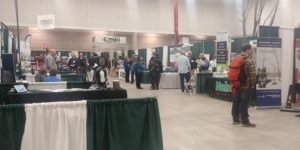
 The 2018 WAA/DNR Annual Conference was held February 18-20 in Green Bay, Wisconsin. This year there was a record attendance of 857 people. Those in attendance were from the private industry, business owners, municipal staff, and state employees. Again, this year there were several different tracks attendants could attend: general sessions, climbers corner, introductory, business and utility. Across these tracks many topics were covered, from insects and pests to climbing and building an arboriculture business. This three-day conference also hosted many different exhibitors from the industry to provide attendees with up-to-date technology, equipment and practices to improve their work. Continue reading “2018 WAA/DNR Conference was an immense success”
New Wisconsin Wildcard available on beech bark disease
Written by: Linda Williams, forest health specialist, Woodruff. Linda.Williams@wisconsin.gov, 920-360-0665.
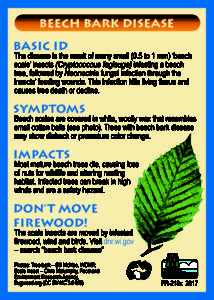
A new Wisconsin Wildcard is available on beech bark disease (BBD). Wisconsin Wildcards are pocket-sized, collectible informational pieces available at Wisconsin state parks. The BBD wildcard may be viewed here. If you’d like to order them, send a request to Forestry.Webmail@wisconsin.gov (ask for publication no. FR-218x).
Beech bark disease will eventually become a problem wherever beech is found. The native range of American beech (Fagus grandifolia) extends into the eastern third of Wisconsin. BBD is the result of a relationship between exotic scale insects and a Neonectria fungus. The disease was first identified in Wisconsin in 2009. Currently, the only known area of the state which has experienced mortality from BBD is Door County.
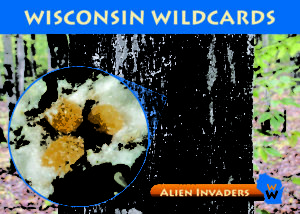
Front and back of the new beech bark disease Wisconsin Wildcard.
The scale insects feed by inserting their mouthparts through the bark on the trunk and branches and sucking the sap from the tree. The fungus, which “hitchhikes” on the scale insects’ bodies, enters the tree through those wounds. The tiny scale insects secrete a white waxy protective covering; when scale populations explode and there are millions of scales on a tree, the tree can appear white from a distance, making it resemble a birch tree. As the fungus enters the tree at numerous points and dead spots under the bark (called cankers) form, the tree becomes weakened, leading to a risk of “beech snap.” Beech snap can occur unexpectedly when the tree still has a full canopy of leaves remaining. Beech snap can create huge problems for park and campground managers who are trying to keep guests safe; there is no way to predict when a tree is going to fail from BBD.
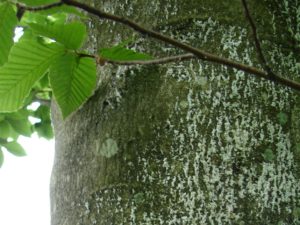
Hundreds of tiny scale insects (covered in white fluff) are present on this small area of beech bark. Photo: Linda Williams
Eventually, the insects and disease take their toll and the beech trees decline and die. Any age of beech tree can be infested, so in stands with significant beech mortality, regenerating trees will become infested as well as mature ones. The good news is that three to five percent of American beech trees are resistant to BBD. Michigan has identified and propagated such trees for a number of years, and have established a seed orchard of resistant trees. BBD is not yet as established in Wisconsin, but already we’ve been able to identify a couple of resistant trees in the area where BBD has killed many trees.
For more info on beech bark disease, visit Wisconsin DNR’s webpage on BBD.
Ash mortality in Central Wisconsin
Michael Hillstrom, forest health specialist, Fitchburg. michael.hillstrom@wisconsin.gov, 608-513-7690
Forest health has relayed the message over the last few years that stand level ash mortality from emerald ash borer (EAB) is occurring in southeast Wisconsin and along some parts of the Mississippi River. Those areas of mortality continue to progress each year, but stand level mortality is no longer limited to just these areas.
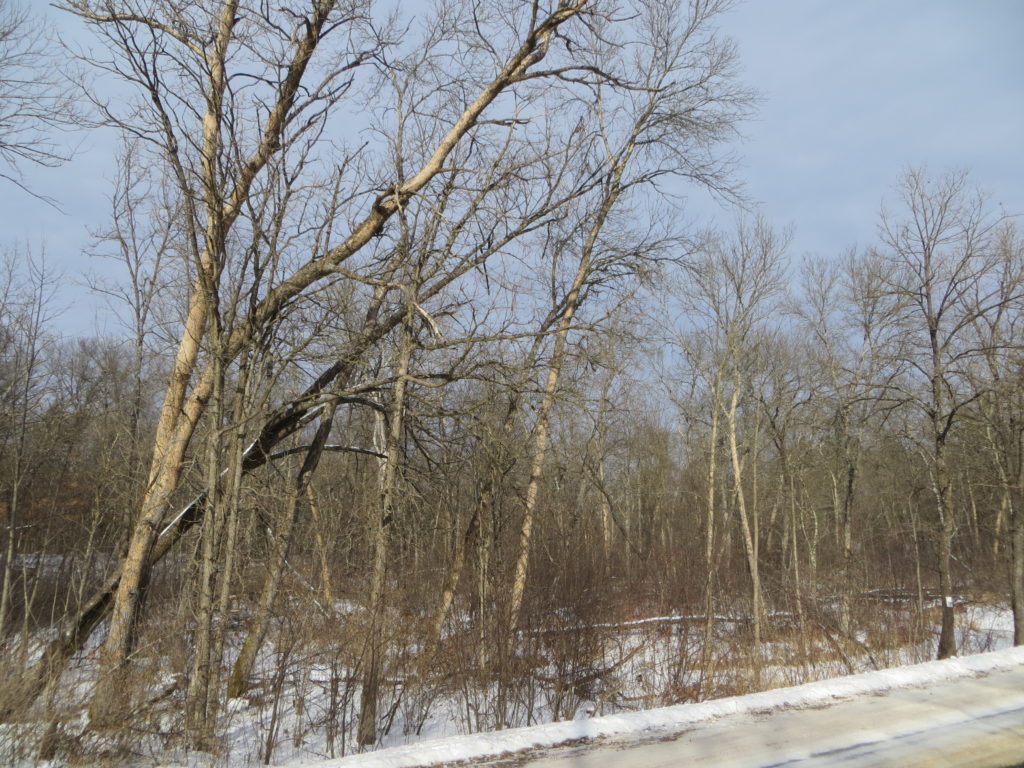
All the ash in this stand near Roche-A-Cri State Park in Adams County are heavily flecked by woodpeckers feasting on EAB larvae. Extensive flecking indicates EAB has fully infested these trees and mortality is imminent. Photo by Mike Hillstrom.
February and March are good times to look for woodpecker damage to ash trees (known as “flecking”), and potentially find new EAB infestations or expansions of known infestations. Winter scouting has allowed us to detect ash mortality from EAB in unexpected places. I was in Adams County in mid-February looking for EAB biocontrol release sites. I was shocked to find a stand where all the ash trees were heavily flecked and likely dead or close to it. We had not previously confirmed EAB in that township or any of the townships directly surrounding it.
This incident further drove home the point for me that even isolated patches of ash are not safe from EAB. We are now past the point of thinking about taking action in ash stands in southern and central Wisconsin; we must now move forward with site assessments, with salvage/pre-salvage harvesting being a high priority for management. In addition, non-ash regeneration growing should be started sooner rather than later. Of course, in urban settings, now is the time to prophylactically treat high-value ornamental ash trees.
The EAB silviculture guidelines will be revised in 2018; stay tuned.
Tamarack mortality appearing in Marathon and Portage counties
Article by: Michael Hillstrom, forest health specialist, Fitchburg. michael.hillstrom@wisconsin.gov, 608-513-7690
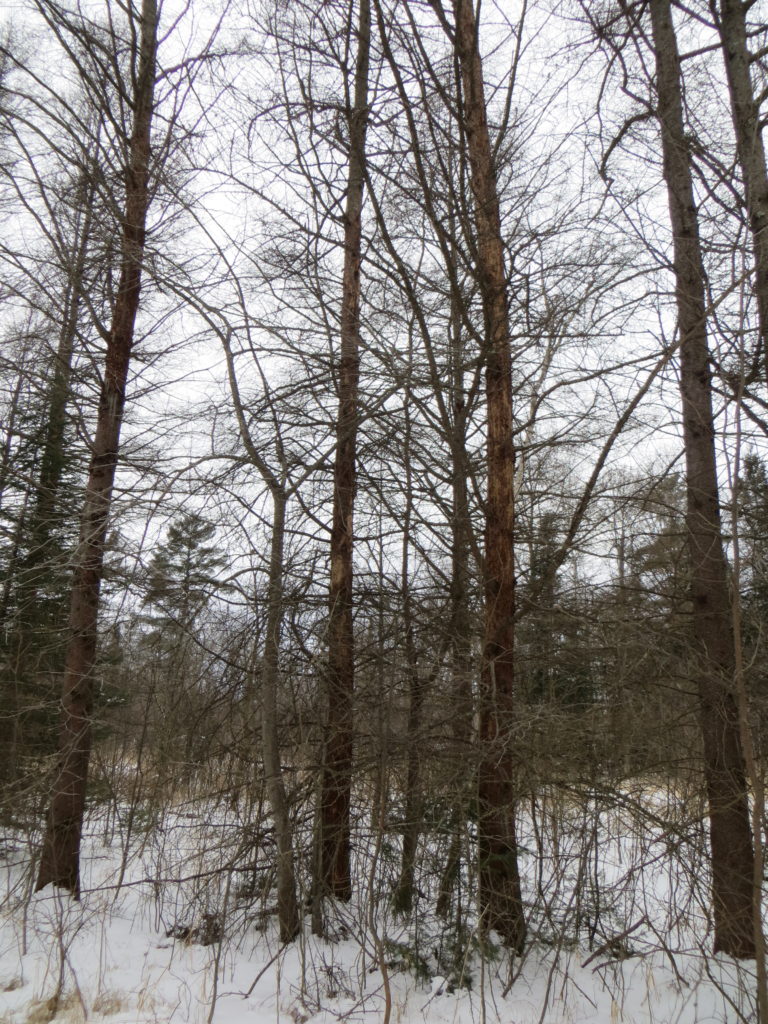
Woodpeckers strip bark off tamarack trees infested with eastern larch beetle, causing them to appear red. Photo by Mike Hillstrom
Foresters reported several new areas of tamarack mortality this winter in Marathon and Portage counties. The culprit continues to be eastern larch beetle (ELB). Although historically there have been periodic outbreaks of this native bark beetle, we have seen damage in Wisconsin every year since 1999. ELB initially attack stressed tamarack but, once in a stand, they often sweep through it over a few years even without additional stressors. The droughts of 2012-2013, defoliation by larch casebearer in 2014 and 2017, and prolonged flooding of stands in 2017 were all likely contributors to ELB infestations in central and northern Wisconsin. Infested stands should be salvage harvested and regenerated when possible, given the difficulty of accessing many tamarack stands.
Basswood bark “explosions” caused by Nectria cankers
Written by: Linda Williams, forest health specialist, Woodruff. Linda.Williams@wisconsin.gov, 715-356-5211 x232
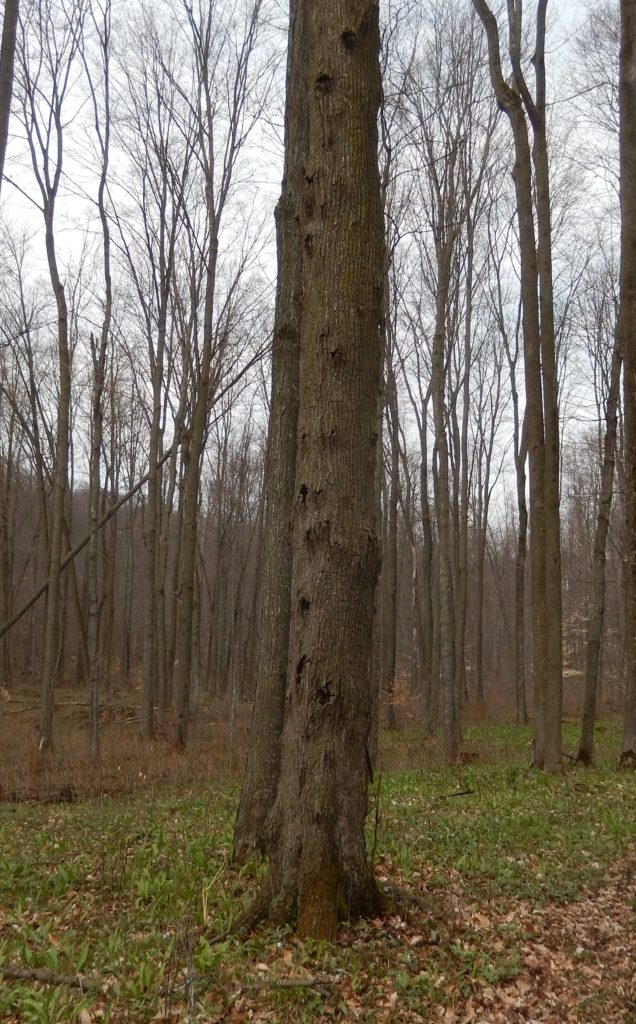
Many small Nectria cankers are present on this basswood tree. Photo: Linda Williams
Winter is a great time to look for cankers on trees, so I thought I’d highlight one this month that you may have noticed but not recognized. Most of you probably know Nectria as “the target canker” because growth patterns give the canker face a series of rings, expanding outwards as the canker ages, causing it to resemble a target. But on basswood, the cankers can appear very different at first glance. On basswood, it may look like there are small “explosions” that occurred under the bark. The bark may be popped out a bit, may have oddly shaped outward growths, and it may or may not be clear that it’s hollow underneath the bark. When you peel away the outer bark and all the gnarly growths, you do end up with a typical Nectria canker face, but on basswood, you often have to dig to get to it. Accompanying photographs show the “bark explosion” appearance that you might notice, as well as what it looks like when you remove the bark.
Nectria cankers are perennial, meaning they grow a little each year. They are made of solid wood (not decayed wood unless another fungus has caused the damage). They typically have staining associated with them; this can cause degrade in lumber value of your final product. If the cankers occur on small branches they can grow to girdle the branch, but the cankers found under the “bark explosions” on the main stem of basswood trees are not typically going to be able to cause that level of damage, and will instead simply continue to grow for many years.
Although this article focused on Nectria on basswood, the fungus can infect a number of other hardwood species. In those other species, you won’t find the “bark explosions” that you see on basswood, and instead will typically find a target shaped, open-faced canker.
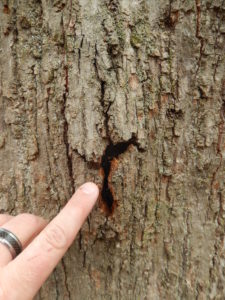
Closer examination of one of the Nectria cankers on the basswood tree shown in the first photo. You can see how the bark appears to be “exploding” from the inside. Photo: Linda Williams
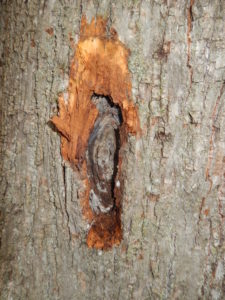
Same canker as in the second photograph, starting to peel away the bark covering the canker face. Photo: Linda Willliams
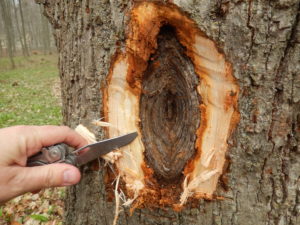
After removing the bark covering the canker, you can see the typical target-shaped canker formed by perennial growth of the fungus. Photo: Linda Williams
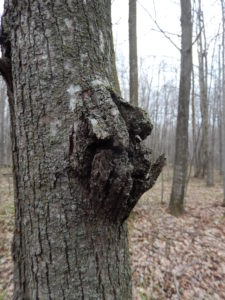
Another example of odd bark growth on basswood associated with Nectria canker. These growths were very thick and solid, but underneath was a small Nectria canker. Photo: Linda Williams
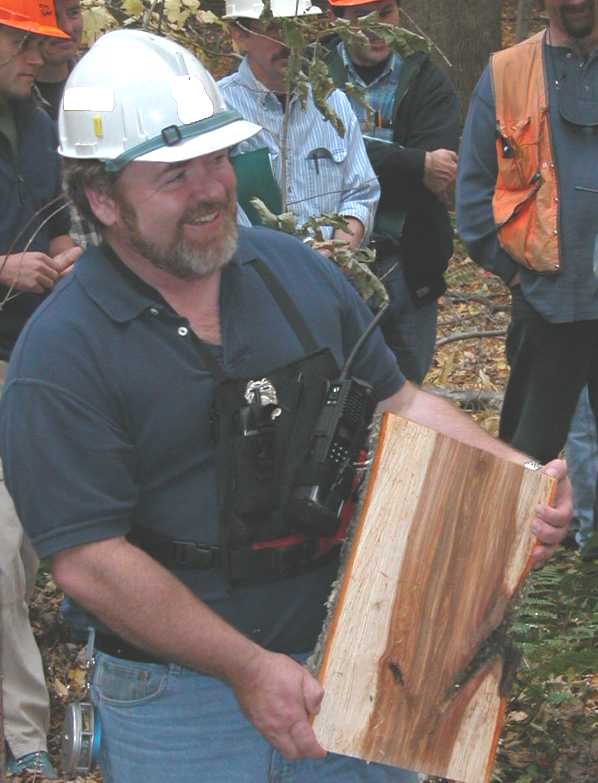
This cross section through a Nectria canker shows the staining that occurs in the tree due to Nectria. Photo: Linda Williams
New finds of emerald ash borer in Wisconsin
Written by: Linda Williams, forest health specialist, Woodruff. Linda.Williams@wisconsin.gov, 715-356-5211 x232
Emerald ash borer (EAB) continues to be found in new areas in Wisconsin, where EAB is tracked at the municipality and township levels. Recently, the insect was found for the first time in Eau Claire County, and there were additional finds in Dane, Dodge and Door counties where EAB is already established.

EAB quarantine map: counties shaded in tan are quarantined for EAB, green areas within counties depict townships and municipalities where EAB has been confirmed.
How did the cold snap over Christmas and New Year’s affect insects?
Written by: Linda Williams, forest health specialist, Woodruff. Linda.Williams@wisconsin.gov, 715-356-5211 x232
Are you wondering how the bitterly cold weather we had in Wisconsin over Christmas and New Year’s affected the insects in your area? You’ll probably be disappointed to learn that, in general, our forest pests handle cold snaps just fine. Here are some examples of what it would take to have an impact on some of our insect pests:
Gypsy moth: Well, it depends. If egg masses were covered by snow (either near the ground or on branches), they were protected from the cold temperatures. If egg masses were exposed, according to a study done in Michigan, it would take several days of temperatures lower than -15 °F to start seeing mortality in eggs. The more days eggs spend below that temperature, the more mortality, although super-cooled eggs or eggs covered by snow can withstand much lower temperatures and survive.
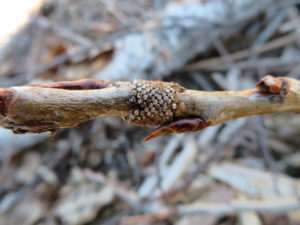
Forest tent caterpillar eggs form a band around an aspen twig. The protective hairs coating the eggs have been removed to show the eggs. Photo: Linda Williams
Forest tent caterpillar: This native insect enjoys our northern climes, so it should be no surprise that it handles the cold quite well. One study found that at temperatures below -45 °F, there was significant mortality. The egg masses of forest tent caterpillars are found near the tips of branches, which are not typically covered with snow.
Spruce budworm: As with forest tent caterpillar, this native insect thrives in the cooler regions of North America and temperatures lower than -40 °F are required to see any mortality.
Emerald ash borer: You may recall in 2014, when we also had bitterly cold temperatures, there was quite a media furor about EAB mortality and some research that was going on in Minnesota. Everyone was hoping EAB would be killed completely in those cold areas. Although some mortality did occur, researchers found that because EAB larvae and pre-pupae are protected under the bark of the tree, temperatures need to be drastically low, or very low for a certain number of days, to see significant mortality. That being said, EAB mortality can occur at temperatures below -13 °F, and, if enough mortality occurs, the spread of the population may be slowed as it has to rebuild from the few individuals that survived the bitter cold.
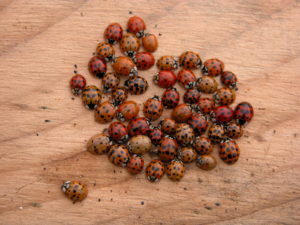
Multicolored Asian ladybeetles cluster together in protected places to wait out the cold. Photo: Linda Williams
Household pests like ladybugs and flies: Those kinds of insects find protected places to spend the winter (sometimes in your house!), and although there can be significant mortality outside, there will be many that survive the cold just fine. They often find protected places that are slightly warmer than ambient air temperatures.
Ticks: Wood ticks and deer ticks overwinter on the ground, under snow, so in areas of the state where there is plenty of snow cover, they’re doing fine so far. Desiccation is usually a much more important problem during the life of a tick than overwintering cold.
Some insects seem to enjoy winter weather, like snowfleas (also known as collembolans or springtails), and winter cutworm, both of which can be found crawling on snow during warmer winter days.
How can insects survive winter? Different types of insects overwinter during different life stages. Some insects overwinter as eggs, because eggs are often quite resistant to desiccation, can have “hairs” covering them, are laid in protected areas, or inserted into needles/bark/etc. to give even more protection. Some adult and larval insects survive winter by supercooling, which is a process in which they eliminate water molecules from their bodies (which, if left behind, could create deadly crystals in their systems). Supercooling is the equivalent to using antifreeze, allowing the insects to survive very cold temperatures. One problem insects can have is when there is a warm-up followed by a sudden cold snap, a situation which also causes problems for trees. When we have steady cold temperatures, insects tend to just hang out like we do, waiting for spring.
National Invasive Species Awareness Week
Written by: Linda Williams, forest health specialist, Woodruff. Linda.Williams@wisconsin.gov, 715-356-5211 x232
National Invasive Species Awareness Week (NISAW) was held from February 26 to March 2 this year. The annual event helps raise awareness and identify solutions to invasive species issues at local, state, tribal, regional, international and national scales. The event not only addresses insects and diseases, but all invasive species, including plants, reptiles, birds, and everything else. Visit the National Invasive Species website for things that you can do increase your awareness of invasive species, or click here to learn about ways you can help.
Upcoming forest products events
Maximizing Forestry Resources in the Midwest
Date: February 21-22, 2018
Location: Forest Products Laboratory, 1 Gifford Pinchot Drive, Madison, WI
More information
Wisconsin Northern China Wood Mission
Date: March 20-30, 2018
Location: Beijing, Tianjin, Qingdao, Guangzhou
More information
Great Lakes Timber Professionals Association’s 10th Annual Spring Celebration
Date: April 9, 2018
Location: Harris, MI
More information
Great Lakes Dry Kiln Association Spring Meeting
Date: April 12-13, 2018
Location: Grayling, MI
More information
Heating the Midwest 2018 Conference & Expo
Date: May 1-3, 2018
Location: Black Bear Casino Resort, Carlton, MN
More information
Renewable energy flooring makes debut
This article is reprinted with written permission from the author.
One step closer to market: Renewable energy flooring makes debut in Union South
By Will Cushman, UW-Madison, Environmental Resources Center
As tens of thousands of visitors each day walk across a new flooring installation in UW-Madison’s Union South in fall 2017, they might not realize they’re participating in what could very well represent a leap into the future of renewable energy production.
A research team led by Xudong Wang, a University of Wisconsin-Madison professor of materials science and engineering, in collaboration with the UW-Madison Grainger Institute for Engineering, has installed a high-tech flooring prototype that harvests the energy of footsteps and converts it into electricity.