September is back to school month. How do you get those kids to settle down and focus after three months off? The answer is as simple as walking right outside your front door! Exposure to nature has shown various impacts on students, from improved academic performance and focus, to reduced Attention Deficit Hyperactivity Disorder (ADHD) symptoms. Research has shown exposure to nature during school hours is positively associated with academic performance, including standardized test scores, graduation rates, and plans to attend a four-year college. Continue reading “Foster student success with trees in your neighborhood”
Did you know?
Getting active in Wisconsin’s urban forest
 By Rob Fontella, fontella@wisc.edu, healthTIDE UW-Madison Public Health
As the weather gets warmer, Wisconsinites are getting out there and enjoying their community and the natural areas the state has to offer. Recently a new effort was launched to encourage communities in Wisconsin to become part of a campaign recognizing the community’s efforts to promote active lifestyles. Continue reading “Getting active in Wisconsin’s urban forest”
Finding bird friendly trees
If you are looking for bird friendly trees and shrubs a database has been created that can help. The Audubon Native Plants Database allows you to enter a zip code and get a list of bird friendly native plants. You can filter based on plant type and what type of bird the plant attracts. The database also shows what kind of birds favor particular plants.
Insights from the Wisconsin Urban Landowner Survey inform tree care outreach
By: Katy Thostenson, DNR social science analyst (Madison), kathryn.thostenson@wisconsin.gov, 608-535-7049
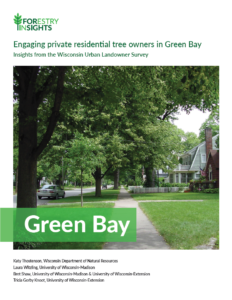 Homeowners in Wisconsin feel the top 5 most important benefits provided by the trees in their yard are:
1) Beauty
2) Shade and cooling
3) Improved air quality
4) Privacy, and
5) Making their neighborhood a better place to live
This list of homeowners’ perceived benefits from their trees is just one valuable insight gathered from the 2017 Wisconsin Urban Landowner Survey. More than 1,700 landowners responded to the survey from Green Bay, Madison, Milwaukee and Wausau, providing insights about their attitudes around tree care, their concerns about tree risks, and their tree care behaviors such as pruning and planting. Continue reading “Insights from the Wisconsin Urban Landowner Survey inform tree care outreach”
Urban Forestry Consultant Directory – Annual update request
For many years the Urban and Community Forestry Program has maintained the Urban Forestry Consultants Directory, a document containing contact information and services provided by consultants who have made themselves known to DNR. Each May, we ask those listed to review their information and submit any necessary updates. We also welcome new submittals at this time, and throughout the year! Continue reading “Urban Forestry Consultant Directory – Annual update request”
Figure out when your trees will bloom
The Morton Arboretum is releasing information monthly on growing degree days. Plants, insects and fungi all develop at various times depending on temperature. Development will speed up or slow down depending on the rise and fall of temperature. Several studies have worked to understand the relationship between heat and development. These studies and information from them help anticipate flowering of trees and shrubs and the emergence of insects based on how many growing days have accumulated. Continue reading “Figure out when your trees will bloom”
Welcoming a new team member
T he Urban Forestry team has recently added a new member, Abner Jacobson. Abner will be an Urban Forestry Grant Specialist. Originally from the East Side of Madison, Abner graduated from the University of Wisconsin in 2017 with degrees in Communication Arts and Political Science. Continue reading “Welcoming a new team member”
Evergreen: A Holiday History
By Dan Buckler, Urban Forest Assessment Specialist
The winter blues are not a modern phenomenon, but something that struck an existential chord in our ancestors. Luckily there were things growing in the forests which sparked hope in hearts until the sun returned, slowly but surely, at the winter solstice. Continue reading “Evergreen: A Holiday History”
Healthcare facilities using green spaces to help in healing
Imagine taking a relaxing walk in a wooded area, listening to the sounds of wind through trees, birds, and water running down a stream and seeing beautiful, vibrant shade of green. This type of an environment has shown numerous benefits, from cleaner air and water to increased health benefits like reduced stress and blood pressure. Continue reading “Healthcare facilities using green spaces to help in healing”
Hoppe Tree Service partners with Brown Deer High School to utilize urban wood
This fall semester, students at Brown Deer High School won’t have to worry about whether or not they have enough lumber supplies and project ideas to perform during their Industrial Arts Wood Shop classes. This is thanks to a partnership between the school and Hoppe Tree Service. The partnership centers around the concept of using locally sourced urban wood from Hoppe Tree Service’s Urban Wood Lab Store. The agreement not only provides lumber for the school, but also allows the student’s non-profit “business” to earn money by processing wood and creating crafts that Hoppe’s Urban Wood Lab Store can then sell to consumers. Continue reading “Hoppe Tree Service partners with Brown Deer High School to utilize urban wood”