
September is back to school month. How do you get those kids to settle down and focus after three months off? The answer is as simple as walking right outside your front door! Exposure to nature has shown various impacts on students, from improved academic performance and focus, to reduced Attention Deficit Hyperactivity Disorder (ADHD) symptoms. Research has shown exposure to nature during school hours is positively associated with academic performance, including standardized test scores, graduation rates, and plans to attend a four-year college. Continue reading “Foster student success with trees in your neighborhood”
Health benefits
Getting active in Wisconsin’s urban forest
 By Rob Fontella, fontella@wisc.edu, healthTIDE UW-Madison Public Health
As the weather gets warmer, Wisconsinites are getting out there and enjoying their community and the natural areas the state has to offer. Recently a new effort was launched to encourage communities in Wisconsin to become part of a campaign recognizing the community’s efforts to promote active lifestyles. Continue reading “Getting active in Wisconsin’s urban forest”
Healthcare facilities using green spaces to help in healing
Imagine taking a relaxing walk in a wooded area, listening to the sounds of wind through trees, birds, and water running down a stream and seeing beautiful, vibrant shade of green. This type of an environment has shown numerous benefits, from cleaner air and water to increased health benefits like reduced stress and blood pressure. Continue reading “Healthcare facilities using green spaces to help in healing”
Trees help clean the air
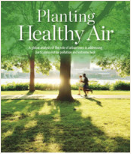 A recently published report from The Nature Conservancy titled “Planting Healthy Air,” detailed which cities could benefit most from tree plantings, focusing on the benefit they could gain from the heat and PM (particle matter) reduction credited to tree plantings. This report found that investing $4 per resident in these cities for tree planting could improve the health of millions, further showcasing trees as a cost-effective solution for air pollution and heat islands, among many other urban difficulties. Continue reading “Trees help clean the air”
Urban Forestry supports health care research
The University of Illinois is taking the lead on a three-year research project exploring urban forestry’s effects on health care spending. The project will be the first to focus specifically on urban forestry’s economic return on investment. Health expenditures of over 4 million people will be analyzed with LiDAR (Light Detection and Ranging) canopy coverage. The project will also result in a free, online tool that can be used to estimate a community’s return on investment for their urban forest.
For more information contact Ellen Clark (EllenA.Clark@Wisconsin.gov), Urban Forestry Communication Specialist, at 608-267-2774.