Spruce Budworm Hits Hemlock And Tamarack

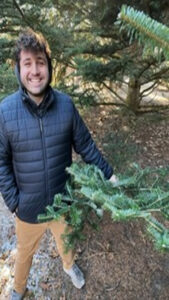
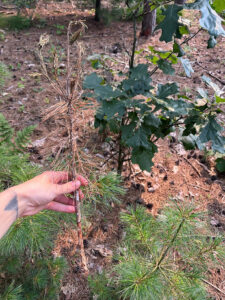
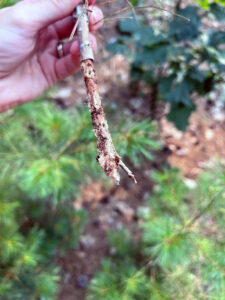
Closeup of hemlock branches showing missing and damaged needles.

Hemlock branches show missing needles, and needles with feeding damage, as the result of spruce budworm infestation. / Photo Credit: Wisconsin DNR

By Linda Williams, Forest Health Specialist, Woodruff
Linda.Williams@wisconsin.gov, 920-360-0665

Spruce budworms are finished feeding for the year, but the damage is still being noticed. That’s especially true in areas where defoliation was severe, such as northeastern Oneida County and southeastern Vilas County.

Spruce budworm prefers to feed on balsam fir and spruce, but in areas with very high populations and severe defoliation, they will also feed on hemlock and tamarack.

Continue reading “Spruce Budworm Hits Hemlock And Tamarack”

Tamaracks Busy Refoliating After Larch Casebearer Defoliation

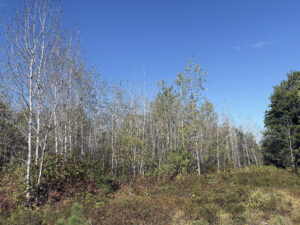
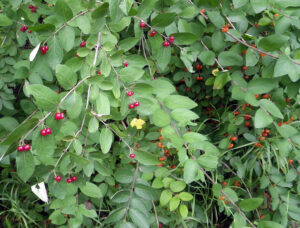
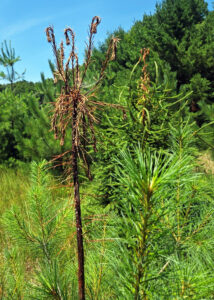
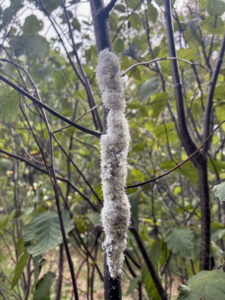
Wide view of stand of trees

Tamarack trees showing the effect of larch casebearer defoliation. / Photo Credit: Wisconsin DNR

By Linda Williams, Forest Health Specialist, Woodruff;
Linda.Williams@wisconsin.gov, 920-360-0665

Earlier this spring, scattered areas of tamarack in North Central and Northeastern Wisconsin showed tan or light brown foliage. Sometimes that is due to frost, but this year it was the work of an insect called larch casebearer.

As the foliage started to expand this spring, the larch casebearer became active and began to feed. The tiny caterpillars mine out the needles of tamarack and use them as “cases” to protect themselves, thus their name.

Continue reading “Tamaracks Busy Refoliating After Larch Casebearer Defoliation”

Forest Health Staffers Plan Public Appearances

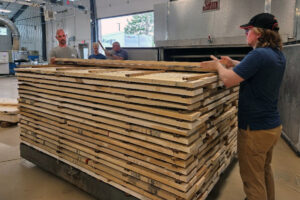
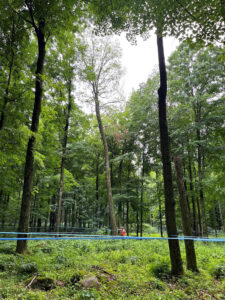
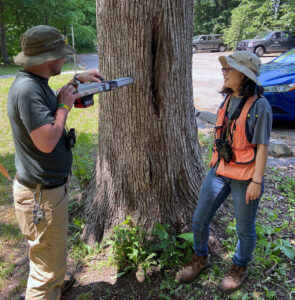
Two DNR workers discuss tree issues in the forest.

Alex Hornung, Wisconsin DNR Forest Health specialist for Central Wisconsin, discusses the tree disease phomopsis with Chief Forester Heather Berklund during a site visit near Minocqua in July 2026. / Photo Credit: Wisconsin DNR

By Art Kabelowsky, DNR Forest Health Communications, Fitchburg;
Arthur.Kabelowsky@wisconsin.gov or 608-335-0167

Alex Hornung, the Wisconsin Department of Natural Resources Forest Health Specialist for Central Wisconsin, will discuss oak wilt biology at a workshop this month.

Hornung will take part in a Wisconsin Forestry Center/Wisconsin Natural Resources Foundation workshop on oak wilt biology and management, focused on information for landowners and the public. The discussion will take place from 1 to 3:30 p.m. Tuesday, Aug. 18, at Schmeeckle Reserve, 2419 N. Point Drive, Stevens Point. She will be joined by Dr. Holly Petrillo, Professor of Forestry at the University of Wisconsin-Stevens Point.

Continue reading “Forest Health Staffers Plan Public Appearances”

2027 Urban Forestry Grants Now Open

By Nicolle Spafford, DNR Urban Forestry Grant Manager
Nicolle.Spafford@wisconsin.gov or 715-896-7099

newly planted trees

Photo Credit: Wisconsin DNR

As of July 1, 2026, cities, villages, towns, counties, tribes and 501(c)(3) nonprofit organizations in – or conducting their projects in – Wisconsin can apply for a regular or startup 2027 Wisconsin Department of Natural Resources (DNR) Urban Forestry grant.

Regular Urban Forestry grants range from $1,000 to $25,000 and grant recipients must match each grant dollar for dollar. These grants fund projects that improve a community’s capacity to manage its trees (e.g., management plans, ordinances, staff training, tree board development, inventories and public education) and projects that help conserve, protect, expand or improve the urban forest resource (e.g., planting, hazard tree removal, pest control). Continue reading “2027 Urban Forestry Grants Now Open”

Community Spotlight: Manitowoc’s Multifaceted Replanting Strategy

By Patricia Lindquist, DNR Urban Forestry Coordinator
Patricia.Lindquist@wisconsin.gov or 715-574-1314

Parks staff Dave Blohowiak and Dawson Boettcher plant a quaking aspen at Fleetwood Park. / Photo Credit: Wisconsin DNR

As a long-time Tree City USA (43 years) and frequent Growth Award recipient (14 years in a row!), Manitowoc has a deep-rooted tradition of supporting urban forestry. After the emerald ash borer was detected in Manitowoc County in 2016, the city redoubled its efforts. Hundreds of dead and declining ash trees have been removed, and thousands of diverse, pest- and disease-resistant trees have been planted to replace the lost canopy.

Manitowoc utilizes a variety of programs, methods and funding sources to plant trees. Read on to learn more about their creative, multifaceted replanting strategy. Continue reading “Community Spotlight: Manitowoc’s Multifaceted Replanting Strategy”

Students Graduate From The Community Tree Management Institute

By Olivia Witthun, DNR Urban Forestry Coordinator
Olivia.Witthun@wisconsin.gov or 414-750-8744

a group of people examining tree leavesCongratulations to the latest class of Wisconsin Community Tree Management Institute (CTMI) graduates! The CTMI wrapped up its sixth cohort mid-June.

CTMI is an advanced training course designed specifically for people responsible for urban forest management who do not have a degree and/or experience in urban forestry. Conversely, they may have technical skills but lack leadership and management experience.

Over six days of intensive training, students acquired the knowledge and skills needed to manage municipal trees and green space. Their exposure to various teaching perspectives gave them a well-rounded 38-hour training experience. The retreat-like setting created by the small class size and interactive learning curriculum reinforced the focus on support-network development with other students, staff and instructors. The capstone of the institute required each student to complete an applied project that benefited their community by utilizing their new skills and knowledge. Continue reading “Students Graduate From The Community Tree Management Institute”

How Big Will My Tree Get?

By Elton Rogers, DNR Urban Forestry Coordinator
Elton.Rogers@wisconsin.gov or 414-294-8675

This is one of my least favorite questions to get as an urban forester/arborist; it’s right up there with “how old is my tree?” The reason I despise this question is not because it is a bad question, but rather it is a complex one. A question that often requires much more discussion than the person who asked it is looking for… Continue reading “How Big Will My Tree Get?”

Tree Species In An Uncertain Future Climate

By Dan Buckler, DNR Urban Forest Assessment Specialist
Daniel.Buckler@wisconsin.gov or 608-445-4578

One of the many challenges for urban foresters in navigating climate change is the fact that while temperatures are elevated across every season, it can still get pretty cold in Wisconsin, even along Lake Michigan. Nonetheless, hardiness zones are shifting, and there is plentiful experimentation underway by Wisconsinites to identify which tree species are appropriate for their location throughout the 21st century.

The Northern Institute of Applied Climate Science produced species vulnerability lists for six locations in Wisconsin, projecting what species are likely at increased risk (i.e. more vulnerable) under different climate change scenarios. Those are great resources that use the same background methodology as a species vulnerability analysis done for the Milwaukee metropolitan area. Continue reading “Tree Species In An Uncertain Future Climate”

Go Outside Funds Available

children learning outdoors

Photo Credit: Wisconsin DNR

The Go Outside Fund provides funding that helps connect youth to outdoor, nature-based learning experiences. Teachers or partner organizations may apply for funding to cover costs that facilitate getting kids outside and hands-on with nature, such as purchasing field supplies or paying for transportation and educator costs. Grants between $100 and $1,500 are available. Educators, as well as eligible organizations, are welcome to apply, with the next deadlines for applications being Sept. 1 and March 1, 2026. Continue reading “Go Outside Funds Available”

When Can I Prune That Elm Tree?

By Elton Rogers, DNR Urban Forestry Coordinator
Elton.Rogers@wisconsin.gov or 414-294-8675

Most urban foresters and arborists are aware of the historical significance of Dutch elm disease (DED). Introduced to the United States in the 1930s, this deadly fungus wreaked havoc on urban and rural forests throughout the United States. In many ways, DED was the impetus for many of the best practices of urban forestry we see today, such as species diversification and modern plant health care practices.

Likewise, most urban forest practitioners understand DED is still very much prevalent today, and if they are managing any lingering American elms, they know they can help decrease their susceptibility to the disease by not actively pruning or wounding them during the growing season. Pruning these elms during the growing season attracts bark beetles, which can carry thousands of DED fungal spores on their bodies. But elm is a complex genus; there are over 30 different species of elm and hundreds (if not thousands) of hybrids and cultivars in the landscape. So, which of these species and cultivars can you prune during the growing season, and which shall you not? Continue reading “When Can I Prune That Elm Tree?”