Trees for clean air

By Robert Allard, Urban and Community Forestry Coordinator, Rhode Island DEM
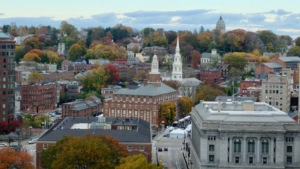
This year, as families all over the country spend more time at home, we have been given the opportunity to appreciate the fresh air that we can enjoy on our own back porches and front stoops more than ever.  Trees are a significant factor contributing to the quality of the air we breathe. Recent research shows that even relatively small trees bring benefits to their neighborhoods. Just a single tree has the potential to filter up to one third of fine particulates such as dust, dirt, soot, and smoke within 300 yards, and can reduce particulate matter inside homes by as much as 60%.
Continue reading “Trees for clean air”

Feature species: swamp white oak

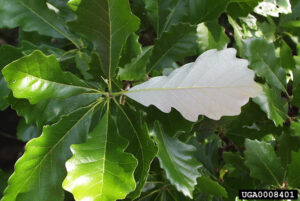
Paul Wray, Iowa State University, Bugwood.org

Scientific name: Quercus bicolor

Native to: northeastern quarter of the U.S. (including southern Wisconsin)

Mature Height*: 50-60+’

Spread*: 50-60’

Form: broad, wide-spreading

Growth Rate*: slow to moderate; 12”-18” per year

Foliage: 5”-6”; glossy green above, white below; leathery with shallow, irregular lobes; leaves often persist into winter

Fall Color: yellow-brown to orange-brown

Continue reading “Feature species: swamp white oak”

Wondering about large yellow wasps?

If you’ve noticed large yellow wasps flying around this summer, you may be wondering whether you’ve seen the Asian giant hornet (aka “murder hornet”). This probably gave you some pause considering all the headlines they received earlier this year,  but fortunately for Wisconsin and much of the Midwest, murder hornets have not yet been found in the region.

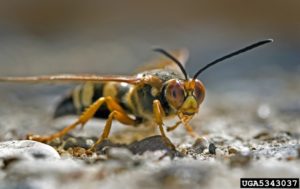
Close-up photo of cicada killer.

The cicada killer is a common native insect in the Midwest.

Continue reading “Wondering about large yellow wasps?”

Be on the lookout for beech leaf disease

By Elly Voigt, forest health lab assistant, Fitchburg

Beech leaf disease (BLD) is a relatively recently discovered, destructive disease of beech trees in the US. It was first observed in 2012 in Ohio and has since spread to areas of Pennsylvania, New York, Connecticut, Rhode Island, Massachusetts and Ontario, Canada. BLD affects our native beech species, American beech (Fagus grandifolia) and ornamental beech species, including European beech (Fagus sylvatica). The disease has not yet been observed in Wisconsin but could become an issue in the future.

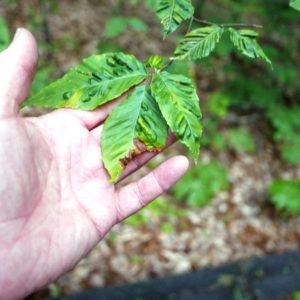
Overhead view of beech leaves show puckering of leaf segments.

Symptomatic leaf puckering of a beech tree with BLD. Credit: Ohio State University.

Continue reading “Be on the lookout for beech leaf disease”

Revised aerial spray guide now available

By Bill McNee, forest health specialist, Oshkosh, Bill.Mcnee@wisconsin.gov, 920-360-0942

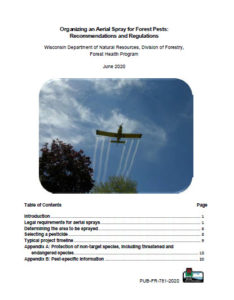
Increasing reports of gypsy moth, forest tent caterpillar and other defoliators this summer may indicate rising populations and increased defoliation over the next few years. A recently revised guide to aerial sprays for landowners is now available.Cover page of the updated aerial spray guide. Continue reading “Revised aerial spray guide now available”

Interactive HRD stump treatment guidelines available online

The HRD stump treatment guidelines are now available in an interactive format to make it easier to obtain stand-specific recommendations. You can find the link called “Interactive guidelines” on the right side bar under “Additional Resources” at the DNR HRD webpage. The user will be asked a series of questions and then a stand-specific recommendation will be provided at the end. The interactive guidelines incorporate Exceptions and Modifications described in the guidelines. Check it out!        

Fall webworm activity in July

By Todd Lanigan, forest health specialist, Eau Claire, Todd.Lanigan@wisconsin.gov, 715-210-0150

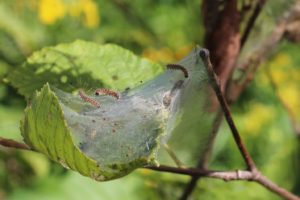
Fall webworm started showing up in early July. This native insect feeds on deciduous trees and shrubs and appears every year in yards and forests. It is often noticed first by the loose webbing over branch tips. It can even completely cover a small tree with webbing. If you look inside the webbing, you will find partially eaten leaves, frass (caterpillar poop) and both live and dead caterpillars.

Fall webworm caterpillars atop

Fall webworm larvae feed within webbed enclosures at branch tips. Credit: Courtney Celley, US Fish & Wildlife Service.

Continue reading “Fall webworm activity in July”

Chlorosis: common causes and next steps in management

Mike Hillstrom, forest health specialist, Fitchburg, Michael.Hillstrom@wisconsin.gov, 608-513-7690

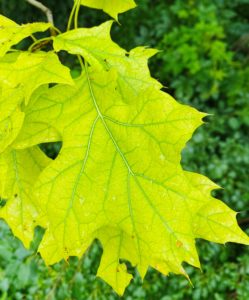
Chlorosis, which is marked by yellow leaves with green veins, is a common tree and shrub issue in Wisconsin. It is often a result of a nutrient deficiency of iron and manganese. 

A chlorotic leaf has yellow leaf tissue with green veins.

A chlorotic oak leaf displays yellow leaf tissue with green veins.

Continue reading “Chlorosis: common causes and next steps in management”

Forestry operations in response to COVID-19

The Division of Forestry offers the following update regarding our operations in response to the ongoing pandemic.

Most employees have been working remotely since mid-March to prevent the spread of COVID-19 to employees, their families and our external partners during this global pandemic.

While the goal is to gradually increase in-person activities that support our mission and Wisconsin’s economy, safety remains a top concern. Therefore, state office buildings, including DNR facilities, remain closed to the public. Although a limited number of gatherings may be approved, virtual meetings continue to be the preferred method for DNR staff and travel remains limited to essential and high-priority work. The majority of DNR staff continue to work remotely, although forestry fieldwork has fully resumed.

If you are planning to meet with a DNR forestry employee in person, such as a site visit for a forest management plan, they will be maintaining a distance of at least six feet, traveling to sites individually to maintain the required social distancing, wearing a mask and following diligent cleaning and disinfecting guidelines.

Thank you for your patience as we continue to safeguard the health of our customers, partners and employees.

2021 DNR Urban Forestry Grant Application now open

Cities, villages, towns, counties, tribes and 501(c)(3) nonprofit organizations in or conducting their project in Wisconsin are encouraged to apply for a regular or startup 2021 Department of Natural Resources Urban Forestry Grant! The grants range from $1,000 to $25,000, and grant recipients must match each grant dollar for dollar. A startup grant of up to $5,000 is available for communities that want to start or restart a community forestry program. Grants are awarded to projects that align with state and national goals for increasing the urban forest canopy and the benefits it provides. Also available this grant cycle is an additional $175,000 federal funding to be used for ash tree removals and replacements. EAB treatment will not be funded with these additional monies. Applications can be submitted starting July 1, 2020 until October 1, 2020.

To view the application and apply visit the Urban Forestry Grants website. If you have questions regarding application process and eligible projects contact your DNR Urban Forestry Coordinator.