Contents of this article are shared for informational purposes only. The Wisconsin Department of Natural Resources does not endorse and makes no representations, expressed, inferred or implied, concerning these organizations, programs or services.
By Paul Fliss, City Forester, City of New Berlin, WI
The City of New Berlin applied for a National Fish and Wildlife Federation (NFWF) Five Star and Urban Waters Restoration Grant in 2017. The proposed project will cover 9.59 acres and encompass the length of Deer Creek and the wetlands to the south and east of the City Center Business District. Common to this area are several species of resident birds, migratory songbirds, owls and waterfowl. Recent history has revealed an abundance of whitetail deer and smaller animals such as muskrats, raccoon, opossum, skunks, various mice/voles and even evidence of a beaver. The habitat for these species is that of an urban to rural interface and wetland transition ecology. The current state of the defined proposal areas vary between ‘poor’ with construction debris, litter and heavily infested invasive species to ‘fair’ with few invasive species and nearly undisturbed lowland habitat, native trees and wetlands plants. Continue reading “Building a Community Ecology Project”
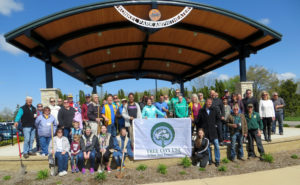 Right now, you’re probably sitting in your office, trying to stay warm and planning for the year ahead. Be sure to check out the following recognition programs and pass the information along to committee and boards who would be interested. The great part is that a single project could be used to help meet all three programs’ requirements! Also be sure to
 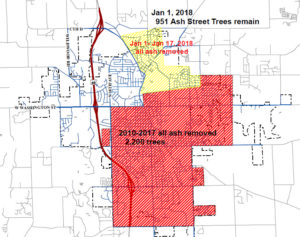 The city of West Bend is in Washington County, about a 30-minute drive north of Milwaukee. More than 32,000 people call West Bend home. Emerald ash borer was first confirmed in West Bend on June 9, 2010. The DNR Urban Forestry team previously showcased West Bend’s efforts to
 The Milwaukee Bucks and American Transmission Co. (ATC) are bringing back their “Trees for Threes” initiative for the 2017-18 Milwaukee Bucks season. Through the Trees for Threes platform, the Bucks and ATC will sponsor the planting of a new tree in Wisconsin for every 3-pointer the Bucks make at home this season.
 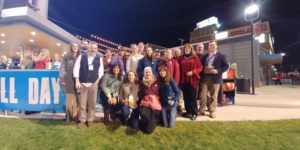 In November, two Urban Forestry team members, Alex Elias (Urban Forestry Grants Manager) and Ellen Clark (Urban Forestry Communications Specialist), attended the Partners in Community Forestry Conference in Tulsa, Oklahoma. The Partners in Community Forestry Conference is a two-day gathering for individuals, nation-wide from industry, non-profit, and state, local and federal agencies alike to come together and collaborate and share ideas, research and interests with others. The conference offered peer-to-peer learning opportunities and educational sessions regarding how to engage communities and partners to promote trees. The conference also fostered discussions regarding how to develop nationwide metrics and stories promoting urban forestry.
 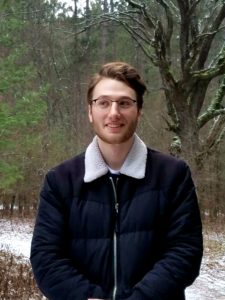 he Urban Forestry team has recently added a new member, Abner Jacobson. Abner will be an Urban Forestry Grant Specialist. Originally from the East Side of Madison, Abner graduated from the University of Wisconsin in 2017 with degrees in Communication Arts and Political Science.
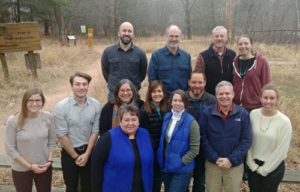 As I reflect on the last year, what stands out most for me is the great people that I work with – both staff and partners!