Recently, there were two reports of a white, frothy substance on the bases of otherwise healthy- looking, mature pine. There are two different possible explanations for this interesting and unusual phenomenon. Continue reading “Frothy foam on pine stems could be stemflow mixing or alcoholic flux”
Properly plant your trees this season
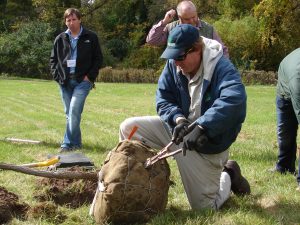 In April we celebrated Earth Day and Arbor Day, the perfect time to plant trees. Planting trees in urban areas provides communities with many benefits, but in order to receive the benefits it must first be properly planted. There are several resources that can help ensure that trees are planted properly. Continue reading “Properly plant your trees this season”
UW-Stevens Point students gain real world skills while helping communities
In an attempt to find an avenue to get small communities in the fold of beginning, or better managing their community tree resources DNR Regional Urban Forestry (UF) Coordinator, Don Kissinger, resurrected memories of his college days when he and his classmates were given a computer simulation to react and manage a fictitious community forestry program. Through this attempt the collaboration with UW- Stevens Point Professor Rich Hauer and his senior level Urban Forestry Lab class began.
Continue reading “UW-Stevens Point students gain real world skills while helping communities”
It’s a bird, it’s a plane: drones purpose in urban forestry
Technology continues to advance at a rapid pace, and urban forestry has been keeping up. One of the newer forms of technology that many urban forestry programs are utilizing is drones, or unmanned aircraft vehicle (UAV).
Continue reading “It’s a bird, it’s a plane: drones purpose in urban forestry”
Urban wood used in local art exhibit
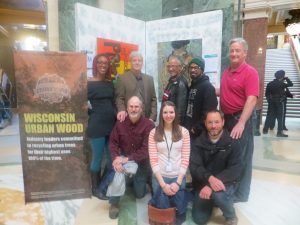 The cabinets in your kitchen, your dining room table, floors in your office, and even the paper you write on are all products made from wood. Usually rural wood is used to make the products, but over the past several years a shift has been made, introducing the use of wood from urban areas to make these, and other, products. For example, urban wood has successfully been used in architecture, creating bowls, staircases, tables and now art. Continue reading “Urban wood used in local art exhibit”
Introducing the Wisconsin Arborist Apprenticeship program
 The State of Wisconsin is leading the way in the green industry by providing the nation’s first Arborist Apprenticeship Program, which will include plant health care as well as tree care. Currently, there are three private tree care companies who have signed on five apprentices who are learning and developing their skills under the direct guidance of certified and skilled arborists. More employers are needed to support the program and be willing to hire apprentices. Apprenticeship is a proven method in numerous industries and the benefits greatly outweigh the commitment incurred by employees of all sizes. It provides a structured training program for developing safe, skilled and productive employees and workforce. This program brings additional benefits: providing a career pathway for individuals to join, growing individuals within the industry, getting the arborist profession recognized as a skilled trade with the U.S. Department of Labor, and helping our private businesses and municipalities find and retain qualified employees. Continue reading “Introducing the Wisconsin Arborist Apprenticeship program”
Second round of Urban Forestry grants awarded
The DNR Urban Forestry Grant program awarded $86,185.66 to five Wisconsin communities for urban forestry projects during our 2017 second round of funding. In order to ensure a pool of catastrophic storm funds throughout the year, we have switched to awarding grants in two rounds, instead of awarding all of our funds in December. The communities who received grants in April include DeForest, Neillsville, Port Washington, Watertown, and Witting. Continue reading “Second round of Urban Forestry grants awarded”
Wisconsin Community Tree Management Institute
 CTMI is a continuing education course specifically tailored to the needs of municipal parks, planning or public works employees who have tree related responsibilities, but do not have a strong background in urban forestry. This training is appropriate for those who manage or contract forestry work, review planting plans, issue permits, or inspect trees. The course focuses heavily on management, rather than the technical aspects of municipal forestry programs. Continue reading “Wisconsin Community Tree Management Institute”
Urban Forestry Consultant Directory – Annual Update
Last year, the format of the DNR’s Urban Forestry Consultants Directory was updated, creating two versions; one searchable by county served and the other, an abbreviated version with companies listed alphabetically. As the application period for the next round of Urban Forestry Grants is fast approaching, we are seeking updates and additions to the consultants directory. Continue reading “Urban Forestry Consultant Directory – Annual Update”
Urban training and events update
Please view our Urban Forestry Training and Events page. This webpage is constantly being updated, but we have recently added some events we would like to let you know about. Various levels of SAWW training will be offered at different locations in the coming months, be sure to pre-register. Additionally, Golden Sands RC&D Council is hosting a workshop on emerald ash borer management. Be sure to check out these and other trainings listed on our page.
For more information contact Ellen Clark (EllenA.Clark@Wisconsin.gov), Urban Forestry Communication Specialist, at 608-267-2774.