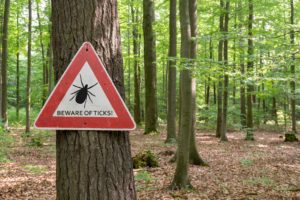
Most people are familiar with the impacts of invasive plants to natural areas, but did you know that invasive plants can be hazardous to human health? Did you also know there is a new app available to learn about tick activity near you and help researchers by recording your own tick encounters?
Continue reading “Invasive plants, ticks and you”
Pest
Pine wood nematode in Waushara County
By Alex Feltmeyer, forest health specialist, Plover, alexandra.feltmeyer@wisconsin.gov, 715-340-3810
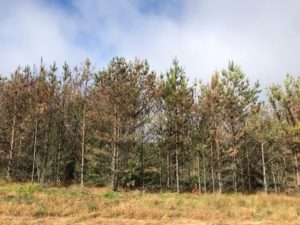
Pine wood nematode (PWN) was recently found to be infecting Scotch pine in Waushara County. Symptoms of pine wood nematode include rapid crown browning (within 3 months) in late summer, rapid drying of wood and presence of blue-stain fungi in the wood.

Symptomatic trees dying from pine wood nematode. Photo by Alex Feltmeyer.
Are you planning to treat your ash trees? If not, stay safe and save money by removing them ASAP!
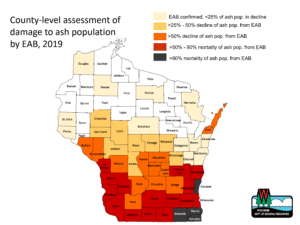
The emerald ash borer (EAB) will kill nearly all of Wisconsin’s ash trees that are not protected by insecticides. If you have healthy ash trees in your yard, you have an important decision to make: protect your trees with insecticides or have them removed. Either way, time is of the essence. If you delay in treating your ash trees, the treatment may be less effective. And if you wait to remove them, removal costs will be greater and safety hazards will only get worse.

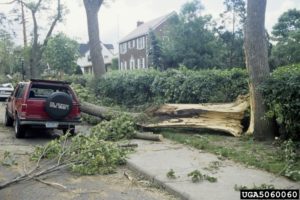
Credit: Joseph O’Brien, USDA Forest Service, Bugwood.org
What makes infested trees so dangerous?
The structural integrity, or strength, of ash branches and tree trunks begins to decline as soon as the tree becomes infested and the wood begins to dry. Lower moisture content increases the risk of branch and trunk breakage, and the timing of breakage is usually unpredictable. Infested trees may also have total trunk failure soon after death, further increasing the chance of dangerous impacts to people and property.
Dead and dying ash are hunting hazard
By Bill McNee, forest health specialist, Bill.McNee@wisconsin.gov, 920-360-0942 and Andrea Diss-Torrance, invasive forest insects program coordinator, Andrea.DissTorrance@wisconsin.gov, 608-264-9247
Hunters should avoid placing tree stands in or near ash trees, especially in the southern half of Wisconsin, the Mississippi River region and in Door County. Many ash trees in these areas are dead or dying from attack by emerald ash borer (EAB), becoming weaker and more likely to break even with little to no added weight. Continue reading “Dead and dying ash are hunting hazard”
Look for gypsy moth egg masses
By Bill McNee, DNR forest health specialist, Oshkosh, Bill.McNee@wisconsin.gov, 920-360-0942
Fall is an excellent time to look for and dispose of gypsy moth egg masses that were laid in the summer. Since egg masses usually don’t hatch until April, information gained from fall/winter surveys can be used to avoid gypsy moth damage before the following spring and summer.

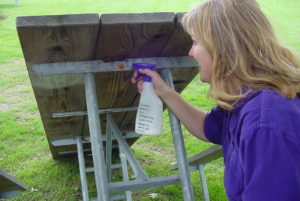
Spraying egg masses with oil kills the eggs inside, preventing hundreds of caterpillars from hatching next spring.
Grants: urban wildlife damage abatement/control
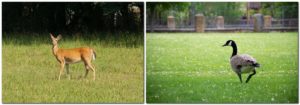
Urban Wildlife Damage Abatement and Control (UWDAC) grants help urban areas develop wildlife plans, implement specific damage abatement and/or control measures for white-tailed deer and/or Canada geese.
UWDAC grants are available to any town, city, village, county or tribal government located within an urban area. Applications must be received on or before December 1 and awards are announced in January of the grant year. For more information please visit, https://dnr.wi.gov/aid/uwdac.html.
Oak health issues in summer 2019
By Mike Hillstrom, forest health specialist, Fitchburg, Michael.Hillstrom@wisconsin.gov, 608-513-7690
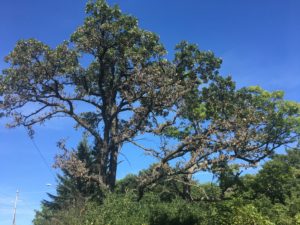
The most commonly reported forest health issue in recent weeks has been unhealthy looking oaks. Symptoms ranging from rapid mortality to gradual decline to superficial have been observed on all species of oak this summer.

White and bur oaks are being impacted by a variety of health issues in late summer 2019, including fungal leaf infections and bur oak blight. Symptoms are most severe in the lower half of this tree’s canopy. Credit: DNR Forest Health.
It’s Firewood Awareness Month: do you know what your options are?
By Andrea Diss-Torrance, invasive forest insects program coordinator, Andrea.DissTorrance@wisconsin.gov, 608-516-2223
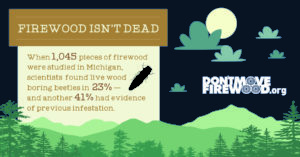
Most people know that using locally-sourced firewood helps prevent the spread of invasive pests and diseases. What may be less well known are the processes for finding local sources of firewood or learning where and how you can collect it yourself. During Firewood Awareness Month, we want to share what options are out there so you can take steps to protect the places you love.

Infested firewood can carry invasive insects and diseases to new places. Buy or gather firewood where you will use it or buy firewood that has been certified as heat-treated and free of pests and diseases. Credit: dontmovefirewood.org.
Continue reading “It’s Firewood Awareness Month: do you know what your options are?”
Spruce needle rust in the north
By Linda Williams, forest health specialist, Woodruff, Linda.Williams@wisconsin.gov, 920-360-0665
Spruce needle rust is showing up in some northern counties. This rust fungus infects current year needles of most spruce species, including white and black spruce, with blue spruce being most severely impacted.

Spore-producing structures of the fungus emerging from infected spruce needles.
Red branches on white pine?
By Linda Williams, forest health specialist, Woodruff, Linda.Williams@wisconsin.gov, 920-360-0665
Large white pines with red wilting branch tips may be caused by a very tiny insect called white pine bast scale (Matsucoccus macrocicatrices). The branch mortality that follows may be caused by an insect/disease complex that is still relatively new to Wisconsin.

Feeding by the white pine bast scale is causing branch tips throughout the tree to wilt and turn red this summer.