Learn more about forestry and forest health issues with these upcoming events in February and March! We link to conference brochures and webpages where you can find detailed information, including registration prices and deadlines where applicable. Continue reading “Upcoming forest health events”
South Central WI Forest Health
Protect your trees from disease by pruning when they have no leaves
By Paul Cigan, forest health specialist, Hayward, paul.cigan@wisconsin.gov, 715-416-4920
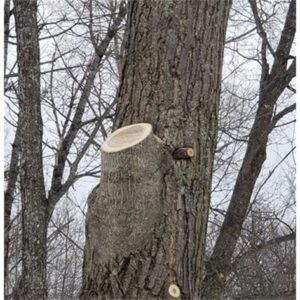 With the new year upon us, healthy lifestyle habits are sure to be on many people’s minds as they plan for changes in diet and exercise. The new year is also the perfect opportunity to make healthier choices for trees! Winter is the ideal time for tree pruning while avoiding harmful, disease-carrying pests such as the tiny beetles that carry oak wilt from one tree wound to another.
“The best time to prune trees that lose their leaves is during winter when the trees are dormant,” said DNR forest health specialist Paul Cigan. “Not only is it easier to see where pruning is needed when leaves are gone, but disease-carrying pests are inactive due to the cold, making pruning both more effective and less likely to invite unwanted pests.”
While pruning in winter reduces the risk of spread through beetles, Cigan pointed out that the disease can spread year-round in firewood. “Several recent oak wilt finds in northern Wisconsin, including a first-ever find in Forest County, may have been the result of infected firewood brought from areas with oak wilt,” Cigan said. “Keep oak firewood where it is cut for one year, or until the bark is naturally loose, to prevent the spread of oak wilt,” he advised.
For more information, visit DNR webpages for oak wilt and firewood.
Pruning tips
Yard trees and trees in urban settings should be pruned throughout their entire life to maintain strong structure and remove dead wood. Young trees should be pruned to establish a central trunk, proper trunk taper and good branch structure and spacing. Older trees should be pruned to remove dead and/or hazardous limbs. “Pruning should not remove more than 25 percent of the live tree crown, and the lower third of deciduous tree trunks should be free of limbs,” advised DNR urban forestry coordinator Don Kissinger. You can find more detailed, step-by-step tips for tree pruning in this DNR tree pruning publication.
Certified arborists who offer pruning and other tree care services can be found at waa-isa.org/arborists/search.asp.
2019 Forest Health Annual Report now available
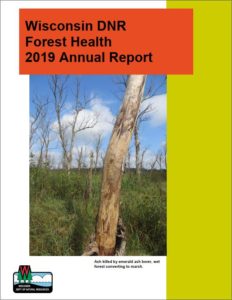
Forest health annual report now available for 2019.
The Forest Health Annual Report summarizes notable impacts for that year of pests, diseases and weather on the health of Wisconsin’s forests. The report is a collaborative product created by DNR forest health specialists from around the state. It outlines the damage and spread of both native and invasive pests and diseases during that year and puts these into context of observations from previous years. Management programs and their results are also described. Highlights from the 2019 annual report include:
- Dramatically increased decline and mortality from emerald ash borer in southern WI
- New county and township detections of oak wilt
- Precipitation record and major storm damage
- Summary of state nursery studies on Diplodia sapinea, galls on jack pine seedlings, and testing new fumigants to replace methyl bromide
This year’s annual report is available on the DNR forest health homepage. Previous annual reports, including historical reports dating back to 1951, are archived and available upon request. Contact your local forest health specialist if you’d like digital copies of any archived annual reports.
New map illustrates damage from EAB
Forest health staff recently produced a map that highlights a gradient of damage from southeastern to northwestern Wisconsin, which roughly corresponds to the length of time EAB has been present in these parts of the state. Whatever the level of damage, homeowners and landowners should consider treating healthy ash, including trees that have responded well to previous treatments, or removing declining, untreated ash before they become hazardous and even more costly to remove.
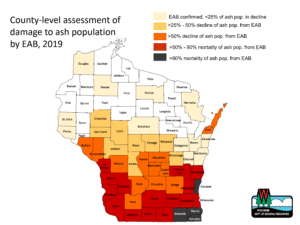
County-level assessment of damage to ash population by emerald ash borer, 2019.
Invasive plants, ticks and you
Most people are familiar with the impacts of invasive plants to natural areas, but did you know that invasive plants can be hazardous to human health? Did you also know there is a new app available to learn about tick activity near you and help researchers by recording your own tick encounters?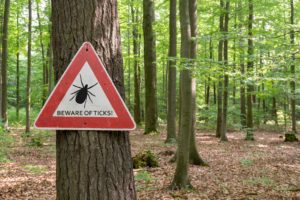 Continue reading “Invasive plants, ticks and you”
Dead and dying ash are hunting hazard
By Bill McNee, forest health specialist, Bill.McNee@wisconsin.gov, 920-360-0942 and Andrea Diss-Torrance, invasive forest insects program coordinator, Andrea.DissTorrance@wisconsin.gov, 608-264-9247
Hunters should avoid placing tree stands in or near ash trees, especially in the southern half of Wisconsin, the Mississippi River region and in Door County. Many ash trees in these areas are dead or dying from attack by emerald ash borer (EAB), becoming weaker and more likely to break even with little to no added weight. Continue reading “Dead and dying ash are hunting hazard”
Slow the spread by sole and tread – revisited!
By Mary Bartkowiak, invasive plants specialist, Rhinelander, Mary.Bartkowiak@wisconsin.gov, 715-493-0920
There’s so much to enjoy about fall and so many activities to take in before the blanket of snow changes our landscape. Something to keep in mind is that the introduction of invasive plants can play a role in changing the landscape, too.
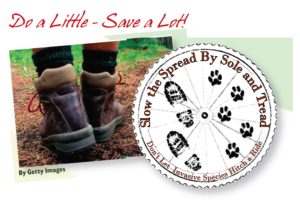 Continue reading “Slow the spread by sole and tread – revisited!”
Look for gypsy moth egg masses
By Bill McNee, DNR forest health specialist, Oshkosh, Bill.McNee@wisconsin.gov, 920-360-0942
Fall is an excellent time to look for and dispose of gypsy moth egg masses that were laid in the summer. Since egg masses usually don’t hatch until April, information gained from fall/winter surveys can be used to avoid gypsy moth damage before the following spring and summer.
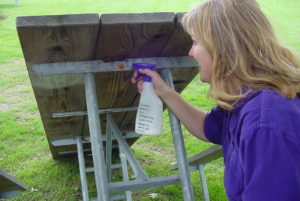
Spraying egg masses with oil kills the eggs inside, preventing hundreds of caterpillars from hatching next spring.
Pesticide applicator training offered in 2020
By Kyoko Scanlon, forest pathologist, Fitchburg, Kyoko.Scanlon@wisconsin.gov, 608-275-3275
The Wisconsin Pesticide Applicator Training (PAT) program with University of Wisconsin Extension is offering a training session for Forestry (Category 2.0) in January 2020. The training is a one-day indoor session to review the materials in the training manual. A certification exam will be administered at the end of the day by Wisconsin Department of Agriculture, Trade and Consumer Protection.
This training will be held January 24, 2020 in Stevens Point at the Portage County Courthouse Annex Building (1462 Strongs Avenue).
Pre-registration is required and the fee is $30. For more information, visit the PAT website. When you are ready to register, visit the PAT program online ordering page.
Fall is a great time to look for HRD
By Mike Hillstrom, forest health specialist, Fitchburg, Michael.Hillstrom@wisconsin.gov, 608-513-7690
Considered one of the most destructive diseases of conifers in the northern hemisphere, HRD is very difficult to eradicate once established. Infestation of a conifer stand may significantly impact stand management, making early detection of the disease extremely important.
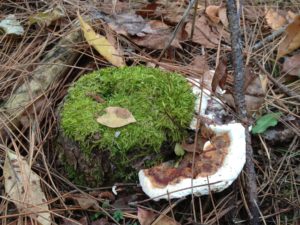
HRD fruit body with new white growth on infested stump. Credit: DNR Forest Health.