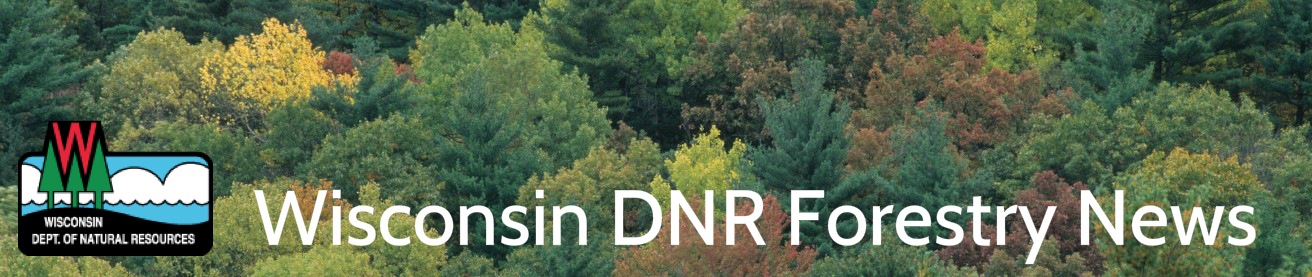
Routinely, DNR North Central Urban Forestry Coordinator Don Kissinger puts a call out to his networking group regarding chainsaw safety training. This past winter he hit the jackpot and received a great response and a first ever request for an Advanced Training. Thus, two courses occurred this past April (Basic & Advanced). Continue reading “Spring 2019 chainsaw safety training”
Technical assistance
Figuring out what tree to plant this spring?
“What tree should I plant?” This is one of the most common questions urban forestry professionals are asked. Well, the answer depends on many different factors. Continue reading “Figuring out what tree to plant this spring?”
Be sure you are properly planting your trees this spring
As the ground begins to soften, it becomes the perfect time to plant a tree. But tree planting is more than just digging a hole in the ground. Improperly planting a tree can cause slowed growth, increased susceptibility to pests, stem girdling roots and premature death. Continue reading “Be sure you are properly planting your trees this spring”
Revised emerald ash borer guidelines now available
By Bill McNee, forest health specialist, Oshkosh, Bill.McNee@wisconsin.gov, 920-360-0942.
The Wisconsin Department of Natural Resources has released updated guidelines to aid woodland owners and managers in managing ash stands in light of the invasive emerald ash borer (EAB). The guidelines that became effective on January 1, 2019 reflect new research, increased pest detections and the anticipated transition to a statewide EAB quarantine (which occurred in March 2018).
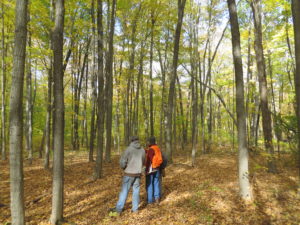
Landowners should work with professional foresters to make management decisions related to EAB on their land.
The silvicultural guidelines are intended to help make informed stand-level decisions regarding management of stands that are not yet infested by EAB and stands that are already impacted by the tree-killing beetle. They should be used along with other materials, including best management practices and other guidance documents, to develop appropriate management plans.
The revised guidelines include recommendations to:
- Implement management plans as soon as practical, across all of Wisconsin, to reduce a stand’s ash component to no more than 20%. More management options are likely to be available by taking immediate action
- Review existing management plans to determine if they need revision due to changes in EAB distribution, stand condition, market prices, etc.
- Diversify woodlands with site-appropriate tree species
- Utilize merchantable ash before trees are infested or killed. It may be appropriate to retain some live ash on site for ecological benefits, species diversity, wildlife habitat, temporary cover or seed production
The guidelines also place a greater emphasis on assessing stand and site conditions before making management decisions. The document offers stand management alternatives for both upland and lowland stands, while recognizing that conversion of lowland ash stands to other forest types will be impractical in many cases.
If you would like more information about emerald ash borer or these guidelines, visit the DNR EAB webpage or talk to your regional forest health specialist.
Revised Heterobasidion root disease guidelines now available
The Wisconsin Department of Natural Resources has released updated guidelines to reduce the risk of introduction and spread of Heterobasidion root disease (HRD) in Wisconsin through preventive stump treatments. The revised guidelines became effective on January 1, 2019, and a professionally designed version will be available soon. Woodland owners are strongly encouraged to work with a professional forester to make management decisions about HRD and preventive stump treatments.
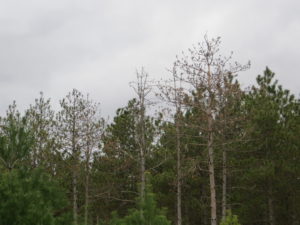
Pocket of HRD-caused thinning and mortality in red pine plantation, Grant County.
Heterobasidion root disease is one of the most destructive diseases affecting conifers in the Northern Hemisphere. In Wisconsin, HRD is most commonly found in pine and spruce plantations. Infection by the wood-decaying Heterobasidion irregulare fungus kills living tissues and leads to growth loss and tree mortality. Spores landing on a fresh cut pine or spruce stump will infect that stump and root system and spread via root contact to neighboring trees, killing them as it invades their root systems. This pattern of spread creates pockets of dead and dying trees that expand outward. Growth reduction of trees leads to economic losses for plantation owners, and mortality of trees, including seedlings and saplings, has long-term implications for future stand composition and management.
The HRD stump treatment guidelines are designed to help make decisions about the use of preventive stump treatments when harvesting a stand. These treatments limit disease introduction by preventing fungal spores from developing on the exposed surfaces of newly cut stumps.
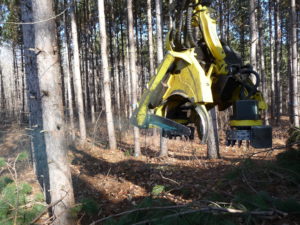
Pesticides used in stump treatments can be applied using logging equipment (blue mist exiting through nozzles in saw bar) or backpack sprayer.
Stump treatments are typically recommended between April 1 and November 30 if a stand is within 25 miles of a known HRD infection site and the stand is more than 50% pine and/or spruce. However, there are other factors to consider when deciding whether to use the preventive stump treatments. Certain situations when you may not need to treat stumps, referred to as “Exceptions” and “Modifications” in the guidelines, consider variables such as economic feasibility, landowner risk tolerance, unexpected weather patterns and future desired stand composition. Highlights of the revised stump treatment guidelines include:
- Timing of treatments and general distance recommendations did not change from older guidance
- Addition of spruce as a species recommended for stump treatment
- Additional Exceptions and Modifications where treatment may not be necessary
- For private landowners with a higher risk tolerance, a 6-mile radius from known infection sites can be considered when evaluating whether to apply treatments
- Even if a stand is considered at low risk for HRD infection, woodland owners should carefully consider the potential impacts to their stand if preventive treatments are not used and HRD becomes established
Along with the guidelines, a web-based HRD map viewer has been launched. This interactive map displays confirmed HRD locations and 25-mile and 6-mile radius buffers around HRD locations. The purpose of this map is to help users determine whether a stand is within either the 25 or 6-mile buffers where stump treatments are recommended. You can enter an address or GPS location, turn map layers on and off, and zoom in and out to an area of interest.
If you would like more information about HRD or these guidelines, visit the DNR HRD webpage or talk to your regional forest health specialist.
Accounting for trees in stormwater models
Accounting for Trees in Stormwater Models is a resource to share with stormwater engineers. The paper is intended to help the stormwater engineering community more easily account for trees in runoff and pollutant load calculations and incorporate them into stormwater management strategies. It summarizes existing hydrologic and hydraulic models that can be applied at the site and small watershed scales to account for the stormwater benefits of conserving existing trees and/or planting new trees. The paper also includes examples of specific techniques to modify stormwater models to account for urban tree benefits, as well as associated resources and tools for estimating the hydrologic benefits of trees in the urban landscape. Continue reading “Accounting for trees in stormwater models”
Does your community have forest-friendly development practices?
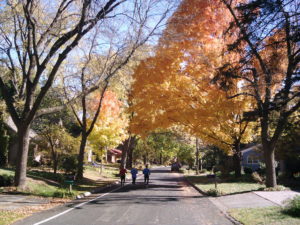 Not every city in Wisconsin has a municipal code or ordinance that includes trees, and even then, those that do have codes may not have forest-friendly ones. A new resource has been created and has taken care of the hard work of determining if your city’s codes are forest-friendly; and if they are not, the resource provides advice on how trees can be more welcome in your neighborhoods. Continue reading “Does your community have forest-friendly development practices?”
A tool to integrate public health considerations in the development of parks and trails
The National Park Service, Department of Health and Human Services and the Center for Disease Control came together to create the “Parks, Trails, and Health Workbook,” a quick guide and outline for incorporating public health considerations in the development of a park or trail. Utilizing the health impacts of these natural areas is a different and critically important way to promote parks and trails. Applying health benefits provides a personal connection and increased relevance to community members and encourages them to act and get outdoors. Continue reading “A tool to integrate public health considerations in the development of parks and trails”
Tree canopy cover benefits assessed using i-Tree Landscape
Imagine that you waved a wand across your community and pollutants from hundreds of tail pipes and smoke stacks disappeared. Far-fetched, no? But that is what trees do every day, and a new tool could summarize some of the magic trees are performing to improve public health and infrastructure. Continue reading “Tree canopy cover benefits assessed using i-Tree Landscape”
Public comment period for EAB silviculture guidelines revision closes October 9
By Bill McNee, forest health specialist, Oshkosh. Bill.McNee@wisconsin.gov; 920-360-0942
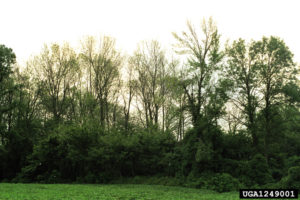
Ash trees dying from an EAB infestation. Photo: Troy Kimoto, Bugwood.org
The Wisconsin DNR is seeking public comments on a proposed revision to silviculture guidelines for emerald ash borer (EAB). Stand-level EAB silviculture guidelines were originally released in 2007, with periodic reviews and updates. A DNR technical team and stakeholder advisory committee prepared the current version using multiple sources of information, including recent research findings, identification and locations of new EAB infestations, economic considerations, and experience gained from implementing previous versions of the guidelines.
The draft document and information about the public comment process can be found at https://dnr.wi.gov/news/input/Guidance.html#open through Tuesday, October 9, 2018. All comments must be submitted by that date.