Urban Forestry News

The 2020 Urban Forestry grant application period is now open!

Cities, villages, towns, counties, tribes and 501(c)(3) nonprofit organizations in (or conducting their project in) Wisconsin are encouraged to apply for a regular or startup 2020 Department of Natural Resources Urban Forestry Grant! The grants range from $1,000 to $25,000, and grant recipients must match each grant dollar for dollar. A startup grant of up to $5,000 is available for communities that want to start or restart a community forestry program. Grants are awarded to projects that align with state and national goals for increasing the urban forest canopy and the benefits it provides.

Communities and organizations interested in applying for a 2020 Urban Forestry Grant may find the grant application informational video to be a valuable resource. It highlights priorities of the Urban Forestry program and discusses several other key aspects of the application process. The video is approximately eleven minutes long and includes topics such as the difference between startup grants and regular grants and how to contact an Urban Forestry Coordinator.

The application period opened July 1, 2019 and closes October 1, 2019. To view the application and informational video, visit the Urban Forestry Grant’s website. If you have questions regarding application process and eligible projects contact your DNR Urban Forestry Coordinator.

Training – street and park tree management

Once again, the Village of Gays Mills will be providing excellent community forestry training for surrounding partners and cooperators. Workshop attendees will learn basic information to manage and care for their trees throughout their lifespan. Use the brochure found here to register. For any questions, please contact Cindy Kohles, Gays Mills Village Forester, at (608) 872-2184.

2019 First Downs for Trees

Green Bay Packers and DNR staff plant a ceremonial Sterling Linden tree in Titletown to help offset the Green Bay Packer’s carbon footprint produced by traveling to away games. Trees naturally sequester carbon dioxide, providing a long-term solution to the problem because trees sequester more and more carbon as they grow larger. This marks the 9th year of the Packer’s First Downs for Trees (FDFT) Program which has planted 5,144 trees to date throughout Brown County.

DNR Secretary Cole, DNR staff and former Packers Johnnie Gray and Gerry Ellis planting a tree.

DNR Secretary Cole, DNR staff and former Packers Johnnie Gray and Gerry Ellis planting a tree.

Continue reading “2019 First Downs for Trees”

Wisconsin DNR Urban Forestry News subscriber survey

Introduction

Providing timely and relevant information to the Wisconsin urban forestry community is a key role of the Wisconsin DNR Urban Forestry program. One of the ways in which this goal manifests itself is through a monthly newsletter received by 5,555 subscribers (May 2019). In order to ensure that the newsletter content is relevant and timely, the Urban Forestry program surveyed subscribers in spring 2019. Results are shown and interpreted below and suggestions made for future newsletter editions. Continue reading “Wisconsin DNR Urban Forestry News subscriber survey”

WAA Summer Conference

WAA Summer Conference

Join the WAA (Wisconsin Arborist Association) for their summer conference and picnic at the Green Lake Conference Center in Green Lake on Tuesday, July 16th. The program committee has put together another excellent lineup for this event. They are offering two educational tracks, one indoors and one outdoors- a little something for everyone.

Topics include:

  • Cold hardiness of EAB
  • Pruning young trees
  • Tree care for wildlife
  • Toxic Wisconsin plants
  • Aerial inspections
  • Nutrients, soils and air spade use
  • Tree ID basics
  • Portable sawmill demonstration

For more information or to register, visit the WAA website at http://www.waa-isa.org/events-programs/summer-conference/.

Invasive plant management on roadsides workshops

Invasive plants have been shown to impact Wisconsin’s economy, environment and human health. Roadsides are a key area where these unwanted plants establish and spread. These right of way habitats are challenging to work in but focused efforts can be successful in preventing spread and reduce invasive plant populations.

To help educate and jumpstart management, The University of Wisconsin-Madison Extension along with 4-Control are conducting roadside invasive plant workshops throughout the state. We invite you to attend one of these five regional workshops. While this training is available to anyone interested, the focus will be on training staff of municipalities that manage vegetation on roadsides. Continue reading “Invasive plant management on roadsides workshops”

Inaugural ‘Good Health Grows on Trees’ conference a success!

Whether it be a hike through the woods, time spent with your family at a local park or sitting beneath the shade of that stately red oak in your backyard, we, as urban forestry professionals and enthusiasts, experience and recognize the physical, mental and spiritual benefits of spending time outdoors in nature.

For decades, scientists have been researching and documenting the health benefits that trees and nature provide, and as urban populations continue to rise, the impact of nearby nature on human health has generated a lot of interest in our world of urban and community forestry.

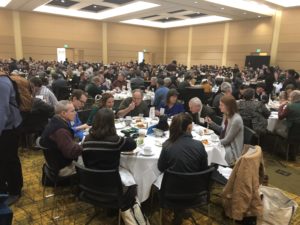
To further that conversation in Wisconsin, the first ever ‘Good Health Grows on Trees: The Influence of Nearby Nature on Public Health’ conference was hosted by the DNR Urban Forestry program at the Rotary Botanical Gardens in Janesville on May 30th.  Continue reading “Inaugural ‘Good Health Grows on Trees’ conference a success!”

Changes in DNR Urban Forestry grant staff

There are some new faces in the DNR Urban Forestry grant staff.

Chase O’Brien started on June 10th as the Urban Forestry Grant Manager located in the Madison office. He has spent the last 3 ½ years working in the DNR Forest Tax Program. He has a degree in Geography & Earth Science with a GIS concentration from UW – La Crosse. Chase enjoys spending his free time seeing live music, traveling, crafting food and drink and playing Ultimate Frisbee. His contact information is Chase.OBrien@wisconsin.gov and 608-640-6143.

Nicolle Spafford is the Forestry Division Budget and Grant Specialist located in the Tomahawk office. She’s been working with our program for several months now, but you’ll be seeing even more of her in the future. Nicolle has been with the DNR Division of Forestry for 28 years. She enjoys spending her free time at her daughter’s academic and sporting events, running races with her daughter, bicycling, reading/collecting books, traveling, training for a marathon and collecting wine corks. Her contact information is Nicolle.Spafford@wi.gov and 715-453-2188 ext. 1274.

Information on the Urban Forestry Grant Program can be found at https://dnr.wi.gov/topic/UrbanForests/grants/index.html. DNR Urban Forestry grant staff may also be reached at DNRUrbanForestryGrants@wi.gov.

Soliciting teachers and students for school tree inventories

There is a small sign in the Milwaukee DNR office that instructs the reader to “Learn of a pine tree from a pine tree.” In other words, to better understand something, one has to see it, feel it, smell it, rather than just reading about it. In urban forestry, this manifests itself in tree inventories, or surveys of individual trees in a given area. Municipalities have recognized the importance of these tree inventories for years, and now, led by a few pioneering teachers, so have some schools. Continue reading “Soliciting teachers and students for school tree inventories”