 The Urban Wood Network, a multi-state collaborative project that is promoting full-circle urban forest management, recently announced its new website. Many felled urban trees are viewed as waste. The Urban Wood Network aims to show that every part of the tree, from seed to sawdust, can be put to its best use, if properly managed. Continue reading “Urban Wood Network launches website”
Urban wood used for Habitat for Humanity
Habitat for Humanity of Washington and Dodge Counties is selling urban rescued wood in its ReStores and using the lumber in Habitat homes being built. Continue reading “Urban wood used for Habitat for Humanity”
Risk tree assessment
This fall Wisconsin DNR Urban Forestry program hosted the inaugural Wisconsin Community Tree Management Institute (WCTMI) graduate workshop. It was held over two days in mid-October at the Green Lake Conference Center. The workshop included presentations and mini-workshops on many topics. One of the topics was risk tree assessment, presented by Dan Traas. Continue reading “Risk tree assessment”
Preparing your site for tree planting
Now is a great time to start planning for tree planting next spring and site preparation is a critical component of that planning. During the end of the growing season, while the landscape is in full bloom and lush, landowners are better able to visualize opportunities to develop wildlife habitat, provide visual barriers, and improve aesthetic qualities on their property. These timely observations and some research will provide the necessary information to determine how newly-established trees will impact their property. Continue reading “Preparing your site for tree planting”
Event will highlight wood-based construction
Advancements in wood technologies have expanded the use of wood in design and construction. Mass timber products such as cross-laminated timber (CLT) have emerged and offer opportunities in tall wood construction. The Wisconsin DNR, in partnership with the Wisconsin Wood Marketing Team, Forest Stewards Guild, and the American Institute of Architects, will host a seminar on September 20, 2017 in Madison, Wisconsin to highlight wood-based construction, mass timber products, applicable building codes, and case studies on how wood technologies can be a sustainable, cost-effective solution for tackling modern design needs. The event will feature a tour of “The Crossroads” located on the Promega campus, showcasing an innovative mix of glulam and cross-laminated timber.
Architects, engineers, designers, developers, general contractors and others interested in wood design are encouraged to attend this informative seminar to be held at the Promega Corporation’s BioPharmaceutical Technology Center (5445 E. Cheryl Parkway, Madison, WI 53711). The registration fee of $30 ($15 for students) includes lunch and refreshments. Visit the event webpage for online registration and additional information.
**Event fulfills 4.5 AIA/CES credits**
For more information, contact Collin Buntrock (715-365-4704, Collin.Buntrock@Wisconsin.gov) or Sabina Dhungana (608-261-0754, Sabina.Dhungana@Wisconsin.gov).
Venturia shoot blight in northern Wisconsin
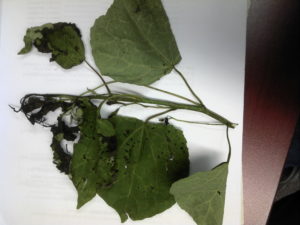
Venturia shoot blighted aspen shoot. Photo by Gerred Carothers.
Venturia shoot blight has been observed throughout northern Wisconsin this summer. Venturia shoot blight is one of the most common fungal diseases of aspen and is favored by cool, wet spring weather.
The pathogen rapidly kills expanding terminal and lateral shoots, causing shoots to wither and droop. It also causes leaf necrosis, appearing as black circles of varying sizes, necrotic curling at the margins, or complete leaf death. The disease is most damaging to seedling and sapling aspen, where it can reduce height growth and cause temporary stem crooking as lateral shoots are released and compete for apical dominance. Disease control is unnecessary in a forest setting.
Written by Paul Cigan, forest health specialist, Hayward (Paul.Cigan@Wisconsin.gov), 715-416-4920.
White spotted sawyer
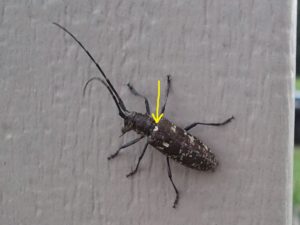
Our native pine sawyer has a “spot” between the elytra (yellow arrow) that Asian longhorned beetle does not have. They also will appear dusty or pitted.
White spotted sawyer, sometimes called Pine Sawyer, is a native longhorn beetle. It is often mistaken for Asian Longhorned Beetle (ALB). How can you tell the difference between our native beetle and ALB? First of all, size: ALB is a big burly beetle, while our native sawyer beetle looks slim in comparison. Second, ALB has a very smooth shiny appearance with distinct white spots on black wing covers, whereas our native sawyer beetle will appear pitted or dusty, and the white spots may be less distinct or absent. Finally, our native beetle will have a nice white dot “between its shoulders” where the wing covers meet, and ALB does not have this.
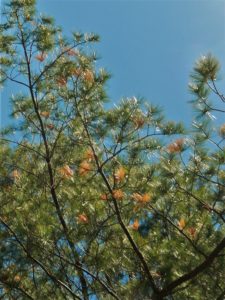
Adult pine sawyer beetles feed on the bark of twigs which can cause branch tip mortality.
Pine sawyer larvae develop in weakened, recently dead, or recently harvested conifers. Larvae first feed in the phloem layer then progress to inner wood. They will pupate within the tree and adults will chew their way out leaving large round exit holes. Adults feed on needles and the bark of twigs. Areas this year which will attract white spotted sawyers include areas of storm damaged pine, and areas of conifer decline due to high water levels, as well as any other areas where conifers are stressed.
If you find a beetle and are unsure whether it’s ALB or our native sawyer, please take some photos to send for identification.
Written by: Linda Williams, forest health specialist, Woodruff, (Linda.Williams@wisconsin.gov), 715-356-5211 x232.
Poplar vagabond aphid
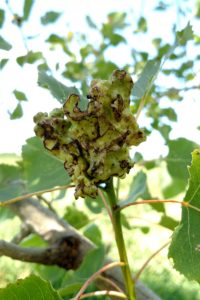
Poplar vagabond aphid feeding on the buds of aspen or cottonwood cause the tree to form a fleshy, hollow gall around the insects.
Galls caused by poplar vagabond aphid form at the ends of aspen and cottonwood branches. The galls are caused by aphids feeding at the tips of twigs. This feeding causes the tree to grow an elaborate structure that the aphids can live inside. One of the galls in the photo is broken open so you can see the aphids inside. This damage does not usually kill the tree, but reduces branch growth because the formation kills the terminal buds. The aphids feed during the spring and early summer within the gall, and then leave to feed on an unknown second host plant. When the aphids leave the gall it will turn brown and woody, and will remain on the tree for several years before weathering off. Adult aphids return later in the fall and lay eggs on the woody gall or in crevices in the bark. Eggs will hatch the following spring and repeat the process. For control, prune the galls prior to egg hatch early in the spring. Because the aphids return to the same trees with the original galls it is common to see a single tree heavily infested while a nearby tree will have no galls at all. I have always seen this problem in trees that are open grown, either along the edge of a stand, along a roadway or fence row, or in a yard. I’m not sure how much of a problem it is in the interior of a stand.
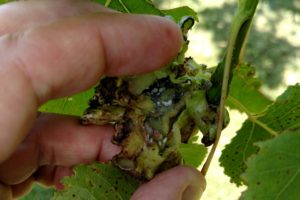
Poplar vagabond aphids, which are covered in a white waxy material, are protected inside the large hollow galls formed by the tree. They suck the trees’ sap.
Written by: Linda Williams, forest health specialist, Woodruff, (Linda.Williams@wisconsin.gov), 715-356-5211 x232.
Oak leaf tier and oak leaf roller
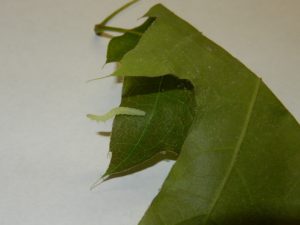
Oak leaf rollers and oak leaf tiers fold over or roll leaves which protect them from predators.
Last month I reported on a location in Marinette where oak leaf tier and oak leaf roller were defoliating oak. Since then I had a report of this same combination of pests causing defoliation near Rhinelander. Typically this defoliation is not severe, but when the leaves are rolled up or folded in half it can make it look like the defoliation is more severe.
Written by: Linda Williams, forest health specialist, Woodruff, (Linda.Williams@wisconsin.gov), 715-356-5211 x232.
Of historical interest, 25 years ago (1992) and 50 years ago (1967)
25 years ago – 1992
- Frost – On June 20, the temperature dropped to 25°F in many locations throughout Wisconsin. This caused injury to several tree species including: black ash, balsam fir, red pine, northern pin oak, and spruce in northwestern Wisconsin, and red pine and northern pin oak in Oneida and Vilas counties, north-central Wisconsin. Severe damage to new shoots of white spruce and balsam fir Christmas trees occurred in Taylor, Langlade, Oneida, Lincoln and Oconto counties. Injury to hardwoods often caused defoliation. Conifers affected by the frost had curled and crooked shoots that eventually died. In Vilas County, most of the injured red pine and oak did not reflush. In Eau Claire County, western Wisconsin, spruce, black walnut and several species of pine were injured. Seedling and sapling-size red pine were injured in Clark and Chippewa counties. Balsam fir, white spruce and white pine Christmas trees in northern Wisconsin were also injured by the early summer frost. Severe loss of new growth.
- White Grubs – Phyllophaga In Marinette County, (Section 16, T30N, R20E) high numbers of white grub larvae were observed in plantings of ash, maple, oak and walnut. These trees were being planted in alfalfa. In Portage county, (NWNW, Section 4, T21N, R7E) all larval stages were present at the time of planting red pine in sod on a 13 acre area. In Washburn County, heavy mortality occurred in a red pine planting due to white grub feeding. Heavy numbers of grubs were reported in new tree plantations in Door, Kewaunee and Manitowoc counties. The adult stage of white grubs, the May and June beetles, were observed in large numbers at night in urban areas in Oconto, Marinette and Marathon counties. Progeny of these beetles could produce heavy damage to nearby young tree plantings in the next two years.
50 years ago – 1967
- Pissodes approximatus Damage by this weevil was associated with red pine plantings on poor sites or frost pockets in the Northeast Area. The most severe infestations were found in Marinette, Oneida and Vilas counties during surveys for Scleroderris lagerbergii (Gremman).
- White-Pine Weevil, Pissodes strobi (Peck). Populations were generally low in all areas of the state. About 10% of the leaders were infested in a small white pine planting in Washburn County (Section 8, T41N, Rl3W). A few terminals of Norway spruce and Scotch pine Christmas trees were infested in Langlade and Oconto county plantations, and survival of weevils was poor in the east central counties. Heaviest infestations were reported from the West Central Area where 20% to 30% of the current leaders were infested in a few white pine plantations and averaged 10% to 15%. Although no white pine weevil control projects were conducted in the West Central Area this year, additional insecticide test plots were established on Black River State Forest plantations. Further investigation of a reported white pine weevil attack on red pine in Trempealeau County reported in 1966 (p. 7, Annual Report 1966) appears more likely to have been the work of Pissodes approximatus Hopkins. Large numbers of these weevils were found on stumps of red pine, cut for Christmas in the fall of 1966, when the site was re-examined in the spring of 1967. Older stumps showed evidence of previous attacks typical of P. approximatus. Evaluation of evidence available indicated that terminal attacks in 1966 occurred because breeding P. approximatus populations exceeded available stump areas and overflowed to the stems and terminals of living trees.
Content taken from the Forest Pest Conditions for Wisconsin Annual Reports from 1967 and 1992.