By Bernie Williams, plant pest and disease specialist, Bernadette.Williams@wisconsin.gov, 608-444-6948
Invasive earthworms in the genus Amynthas, more commonly known as “jumping worms,” were first identified in Dane County in 2013 and have since been reported in 45 of the state’s 72 counties. Verified species in Wisconsin are Amynthas tokioensis, A. agrestis, and the closely related Metaphire hilgandorfi, first identified in September 2017. A. tokioensis is the most common of the three species. A. agrestis typically appears in combination with A. tokioensis but rarely on its own.
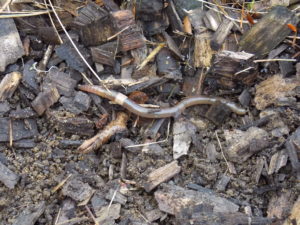
Adult jumping worms are identified by their dark brown color and smooth, milky-white band near head.
Continue reading “Preliminary findings are promising first step in control of jumping worms”
 Wisconsin Community Tree Management Institute (CTMI) is a unique training experience designed for municipal staff with tree management responsibilities but without a strong background in urban forestry. The program is ideal for staff who spend just part of their time dealing with trees. Conversely, those with a background in urban forestry but new to management, will also find it useful. CTMI consists of approximately 38 instruction hours and requires students to complete an out-of-classroom project.
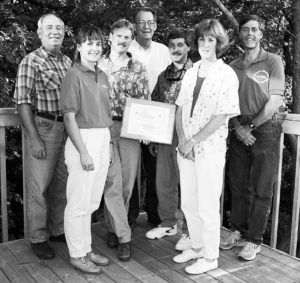 The history of the Wisconsin DNR Urban Forestry program is closely tied to the history of urban forestry in the United States. Although the term ‘urban forestry’ did not come into use until 1965, the concept of an integrated approach to the management of the urban forest ecosystem began to take shape as early as the 1930s. The devastation caused by diseases such Dutch elm disease, phloem necrosis, and oak wilt was a driving force in the development of the field of urban forestry. The term ‘urban forestry’ was first used in 1965 at the University of Toronto to describe a graduate student’s research on the successes and failures of municipal tree planting projects in Toronto. The term was quickly adopted in the United States, where urban forestry had already begun to grow into a national movement. (Source: Mark Johnston, “A Brief History of Urban Forestry in the United States,” Arboricultural Journal 1996, Vol. 20, pp. 257-278.)
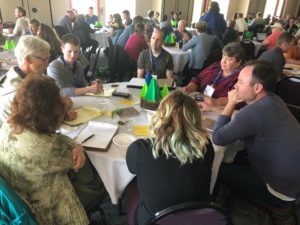 The Urban Forestry Team provides guidance, training, information, funding and professional connection opportunities to municipal foresters and other professionals to achieve sustainable urban forestry management. In a (hickory) nutshell, our work falls into the following five categories:
 “What is it about this place?” I wondered. “Why does this city feel so harsh, so disheartening?”