Revised Heterobasidion root disease guidelines now available

The Wisconsin Department of Natural Resources has released updated guidelines to reduce the risk of introduction and spread of Heterobasidion root disease (HRD) in Wisconsin through preventive stump treatments. The revised guidelines became effective on January 1, 2019, and a professionally designed version will be available soon. Woodland owners are strongly encouraged to work with a professional forester to make management decisions about HRD and preventive stump treatments.

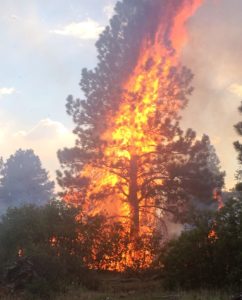
Pocket of HRD-caused thinning and mortality in red pine plantation, Grant County.

Pocket of HRD-caused thinning and mortality in red pine plantation, Grant County.

Heterobasidion root disease is one of the most destructive diseases affecting conifers in the Northern Hemisphere. In Wisconsin, HRD is most commonly found in pine and spruce plantations. Infection by the wood-decaying Heterobasidion irregulare fungus kills living tissues and leads to growth loss and tree mortality. Spores landing on a fresh cut pine or spruce stump will infect that stump and root system and spread via root contact to neighboring trees, killing them as it invades their root systems. This pattern of spread creates pockets of dead and dying trees that expand outward. Growth reduction of trees leads to economic losses for plantation owners, and mortality of trees, including seedlings and saplings, has long-term implications for future stand composition and management.

The HRD stump treatment guidelines are designed to help make decisions about the use of preventive stump treatments when harvesting a stand. These treatments limit disease introduction by preventing fungal spores from developing on the exposed surfaces of newly cut stumps.

Cutting bar on logging equipment spraying blue chemical used in HRD stump treatments.

Pesticides used in stump treatments can be applied using logging equipment (blue mist exiting through nozzles in saw bar) or backpack sprayer.

Stump treatments are typically recommended between April 1 and November 30 if a stand is within 25 miles of a known HRD infection site and the stand is more than 50% pine and/or spruce. However, there are other factors to consider when deciding whether to use the preventive stump treatments. Certain situations when you may not need to treat stumps, referred to as “Exceptions” and “Modifications” in the guidelines, consider variables such as economic feasibility, landowner risk tolerance, unexpected weather patterns and future desired stand composition. Highlights of the revised stump treatment guidelines include:

  • Timing of treatments and general distance recommendations did not change from older guidance
  • Addition of spruce as a species recommended for stump treatment
  • Additional Exceptions and Modifications where treatment may not be necessary
  • For private landowners with a higher risk tolerance, a 6-mile radius from known infection sites can be considered when evaluating whether to apply treatments
  • Even if a stand is considered at low risk for HRD infection, woodland owners should carefully consider the potential impacts to their stand if preventive treatments are not used and HRD becomes established

Along with the guidelines, a web-based HRD map viewer has been launched. This interactive map displays confirmed HRD locations and 25-mile and 6-mile radius buffers around HRD locations. The purpose of this map is to help users determine whether a stand is within either the 25 or 6-mile buffers where stump treatments are recommended. You can enter an address or GPS location, turn map layers on and off, and zoom in and out to an area of interest.

If you would like more information about HRD or these guidelines, visit the DNR HRD webpage or talk to your regional forest health specialist.

2018 Forest Health Annual Report now available

The Forest Health Annual Report summarizes notable impacts pests, diseases and weather on the health of Wisconsin’s forests. The report is a collaborative product written by DNR forest health specialists from around the state. It outlines the damage and spread of both native and invasive pests and diseases during that year and puts these into context of observations from previous years. Management programs and their results are also described. Highlights from the 2018 annual report include:

  • American beech with resistance to disease-causing scale insect entered into a breeding program for species conservation and reintroduction
  • Confirmation of jumping worms in northern counties
  • Biological control of emerald ash borer
  • Closure of the state gypsy moth suppression program
  • Innovation in survey of the invasive plant lesser celandine
  • Dieback and mortality in balsam fir caused by freezing weather in April followed by unseasonably hot temperatures in early May

The 2018 report and others dating back to 2003 are available on the forest health publications page. Historical reports dating back to 1951 are archived and available upon request. Contact Marguerite Rapp at marguerite.rapp@wisconsin.gov for more information on the archived reports.

Jack pine budworm not likely an issue in 2019

By Todd Lanigan, forest health specialist, Eau Claire, Todd.Lanigan@wisconsin.gov, 715-210-0150. 

No caterpillars or egg masses were found in the 2018 jack pine budworm surveys. Done in the spring for caterpillars and the fall for egg masses, surveys help predict jack pine budworm defoliation in the coming year. Surveys were conducted in the west central part of the state, covering portions of Dunn, Eau Claire, Jackson, Monroe, Pierce and St. Croix counties. 

Jack pine budworm caterpillar on spruce needle tip.

Caterpillars emerge in the spring and feed on host tree foliage. 

Cluster of jack pine budworm eggs on tip of spruce needle.

Egg masses are deposited on the tips of host tree foliage. 

In Wisconsin, jack pine budworm feeds on all native species of pine: jack, red and white. It is occasionally found on white spruce, but this has only been documented where spruce trees were located near an infested pine plantation.

Jack pine budworm regularly cycles from low to high populations, with outbreaks occurring every 8-10 years on average. During an outbreak, defoliation from these caterpillars can be widespread and lead to growth loss, topkill and tree mortality.

Three host trees showing severe defoliation and mortality due to jack pine budworm defoliation.

During a jack pine budworm outbreak, defoliation and mortality can be severe.

Wisconsin forests are overdue for an outbreak, with the last one occurring from 2005-2009, but annual surveys indicate that populations of jack pine budworm are still low enough to be undetected. Based on the 2018 surveys, jack pine budworm should not be a problem in 2019.

Help your heart by planting trees

February is American Heart Month. Get heart healthy the easy way, head outside! Exposure to trees relaxes and restores your mind, lowering your blood pressure and heart rate. This helps to reduce incidences of cardiovascular and lower respiratory diseases. Conversely, tree loss from the spread of the emerald ash borer, and other insects and diseases, is associated with increased mortality related to cardiovascular and lower respiratory diseases.

walking in park Continue reading “Help your heart by planting trees”

August Hoppe inaugurated to the TCIA Board of Directors

“Urban forestry and tree care is a great industry to be involved with and something that we all should be proud of. Industry professionals leave a lasting legacy in caring for the trees in our community each and every day, and it’s important that we spread the word and help future generations understand the importance of nature and trees.” Continue reading “August Hoppe inaugurated to the TCIA Board of Directors”

2020 Forest Action Plan development begins

Development of Wisconsin’s 2020 Forest Action Plan is beginning now. Over the next year and a half, the Division of Forestry, along with Wisconsin’s greater forestry community, will be working collaboratively to review trends in the current state of forestry and identify future strategies that can help the forestry community refine how we collectively invest resources to address major management and landscape priorities. Engaging with all members of the forestry community is important to the success of the Forest Action Plan.

Here is more information on the Forest Action Plan, the timeline, and how the forestry community will be engaged.

To get updates on the process and progress of the 2020 Forest Action Plan, please sign up for the Forest Action Plan GovDelivery list.

Find up-to-date information on the 2020 Forest Action Plan online here.

If you have questions about your involvement or the Forest Action Plan in general, please contact Amanda Koch at AmandaA.Koch@wisconsin.gov  or at (608) 576-8146.

NR 46 available for public comment

By R.J. Wickham, Tax Law Section Chief – Forestry Field Operation Bureau, Division of Forestry
Contact info: (920) 369-6248, Richard.Wickham@wisconsin.gov

The proposed rules affecting Chapter NR 46 of Wisconsin’s Administrative Code related to Forest Tax Programs, including the Forest Crop Law (FCL) program and the Managed Forest Law (MFL) program, are available for public review and comment.

Signed into law on April 2016, 2015 Wisconsin Act 358 made a number of significant changes to the administration of the FCL and MFL programs requiring a comprehensive update to NR 46. The Forest Tax Section is proposing amendments to NR 46 to become consistent with statutory changes made to Ch.77, Wis. Stats. The proposed updates also include additional changes to NR 46 to incorporate long standing policy and streamline administration of the programs. Our sincere thanks go to the many individuals and partners, including the Wisconsin Private Forestry Advisory Committee, whose review and feedback helped shape these proposed amendments.

Here is the Notice of Public Hearing FR-23-16 document which includes hearing information and explains the process of submitting comments:
https://dnr.wi.gov/news/input/documents/rules/FR2316PublicHearing.pdf

The proposed rule can be accessed here:
https://dnr.wi.gov/news/input/documents/rules/FR2316DraftRule.pdf

Biochar: An Emerging Market for Underutilized Woody Biomass

By Sabina Dhungana, Forest Products Specialist

biochar sample

This is a sample of biochar produced from coarse woody biomass.

What is Biochar?
Biochar is a pure carbon product made from organic material that is generally produced through a process called pyrolysis. Pyrolysis is the decomposition of organic matter at elevated temperatures in an environment with limited oxygen.

Biochar Production and Opportunities for Wood Businesses
Biochar can be produced using woody biomass such as wood chips, sawdust, shavings or bark that is generated from timber harvesting or as a by-product of wood products manufacturing.

Biochar production systems can be classified as either pyrolysis or gasification systems. The pyrolysis of biomass results in three main products: a solid (bio-char), a liquid (bio-oil), and a gas (syngas). Furthermore, pyrolysis becomes self-sustaining as syngas that is produced combusts, generating additional heat for the production process. Gasification on the other hand produces smaller quantities of biochar in a directly-heated reaction vessel with introduced air. Although pyrolysis systems result in higher concentrations of biochar, both production systems can be developed as mobile or stationary units as per the need and availability of the feedstock. Continue reading “Biochar: An Emerging Market for Underutilized Woody Biomass”

Primary mill mapping tool released

By Collin Buntrock, Forest Products Team Leader

The Forest Products Services program recently worked with the Technology Services Section in the Division of Forestry to develop an interactive mapping tool highlighting Wisconsin’s primary wood-using mills.

The new mill mapping tool highlights Wisconsin’s primary mills.

The goal of the mapping tool is to facilitate better marketing of forest products by connecting value-added industries with Wisconsin’s primary mills and by assisting forest managers and loggers with identifying markets for harvested timber. Mill data can be refined by county, species processed, products utilized, and products sold and then downloaded for later reference.

Wisconsin’s primary forest products industry consists of firms that manufacture logs and pulpwood into wood and paper products. Specific examples include sawmills, veneer plants, pulp mills and firewood processors, as well as companies that manufacture products such as composite panels (e.g. oriented strand board, particleboard), shavings, utility poles, wood pellets, and log buildings.

Mill data featured in this tool is collected by Forest Products Services staff as part of the USDA Timber Product Output survey. The FPS program will refine this dataset beginning in early 2019. It should be noted that a subset of mills opted-out of the mill dataset. Therefore, you may be aware of additional mills that are not included in the mapping tool.

If you know of a business that would like to be included in this mapping tool, please send an email to a staff member on the Forest Products Services team and include their contact information, species and products utilized, and products produced.