By Mike Hillstrom, forest health specialist, Fitchburg, Michael.Hillstrom@wisconsin.gov, 608-513-7690
Two invasive insects, hemlock woolly adelgid (HWA) and elongate hemlock scale (EHS), pose serious threats to Wisconsin’s hemlock trees. Although neither insect is established in Wisconsin, both insects have been found in recent years on infested nursery stock or live tree material that was shipped into the state. Fortunately, these introductions were detected and the plant material destroyed. But with HWA established in hemlock stands of several Michigan counties along Lake Michigan, natural spread to Wisconsin is anticipated.
Because of the risk, forest health staff from the Department of Natural Resources (DNR) and the Department of Agriculture, Trade and Consumer Protection (DATCP) are conducting surveys for early detection of these pests. Both pests could appear in many settings including urban and rural forests, yard trees and holiday tree plantations so everyone has a role to play in looking for these pests and reporting what they see.
HWA and EHS both feed on tree needles with sucking mouthparts. When populations are large enough, this feeding causes excessive fluid and nutrient loss, leading to declining tree health. Both insects can be found together on infested hemlock trees.
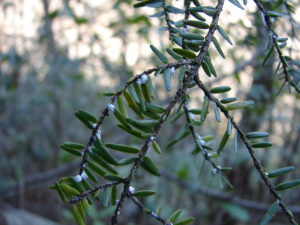
Characteristic white wax coating of adult hemlock woolly adelgid.
There are a few key ways to spot these insects. HWA is most obvious in winter when white, wax-covered adults are present. You may also see hemlock foliage turning gray-green in color as tree health declines. Adult EHS have a waxy cover and feed on the underside of hemlock, spruce and fir needles. Damage from EHS appears as yellow banding on needles. Crowns appear progressively thinner as infested needles die and fall off prematurely. Both insects also have tiny immature crawlers that may be seen moving on infested trees.
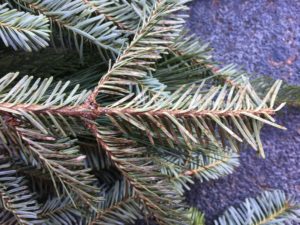
Adult elongate hemlock scale and yellow needle banding (Credit: WI DATCP).
If you suspect you’ve found either HWA or EHS, please report it immediately to your local DNR forest health specialist. For more information about HWA, visit the DNR and DATCP webpages. To learn about EHS, visit the DATCP webpage.
 elebration of educating and assisting Wisconsin’s private woodland owners by attending one of their Open Woods events on Saturday, May 18, 2019. WWOA members around the state will celebrate by opening their private woodlands to the public and hosting a variety of family-friendly events to showcase how they have improved their land through forest management.